


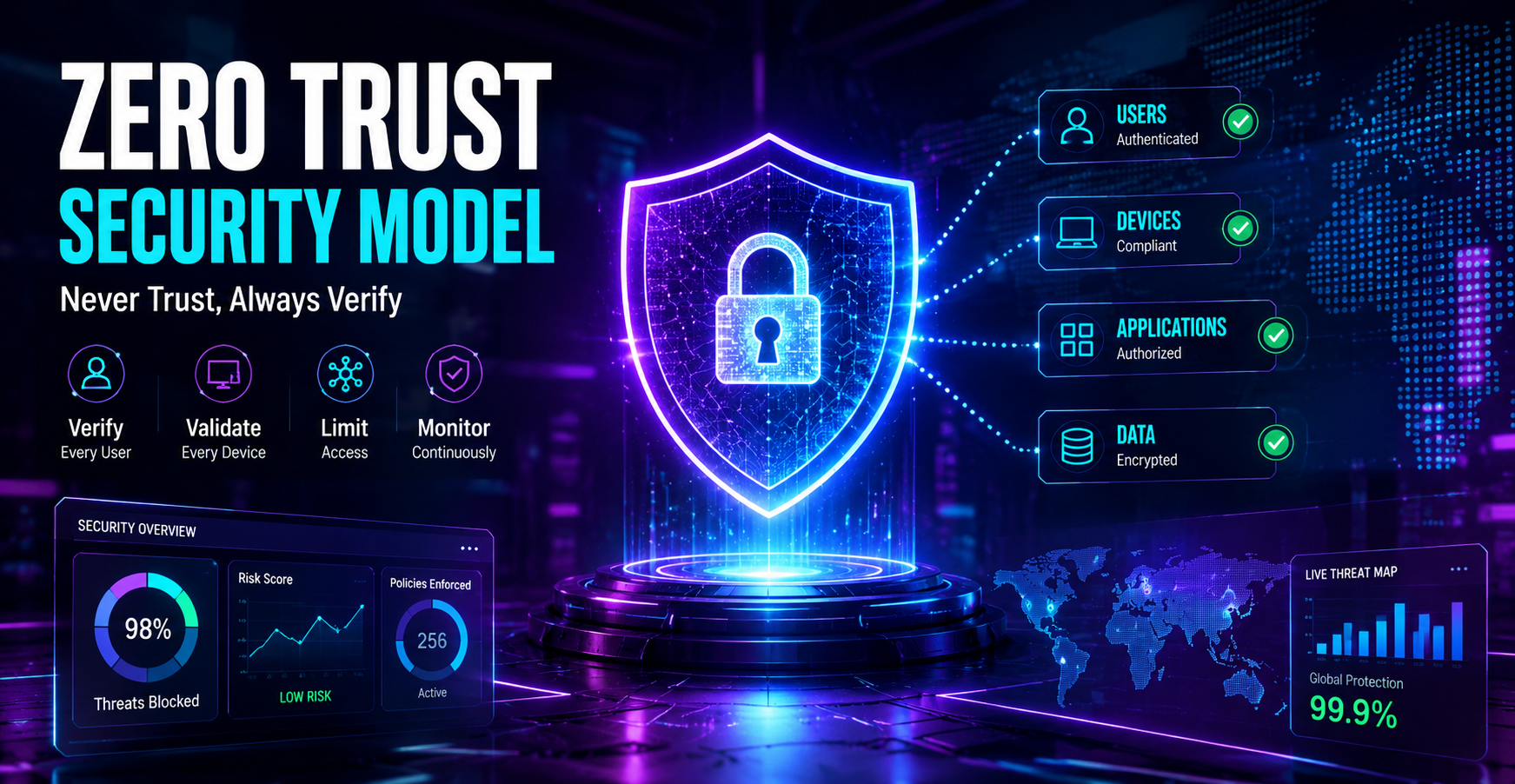
Zero Trust Security Model: The Future of Cyber Security Every Student Should Understand
In today's interconnected digital world, cyber threats are evolving faster than ever before. Organizations are facing increasingly sophisticated attacks, including ransomware, phishing campaigns, insider threats, credential theft, and advanced persistent threats (APTs). Traditional security approaches that rely on protecting the network perimeter are no longer sufficient to defend against modern cyber risks.
As businesses continue adopting cloud computing, remote work, mobile devices, and Internet of Things (IoT) technologies, securing digital assets has become more challenging. This has led to the rise of a revolutionary cybersecurity approach known as the Zero Trust Security Model.
The Zero Trust Security Model has become one of the most important cybersecurity frameworks adopted by governments, enterprises, financial institutions, healthcare organizations, and technology companies worldwide. For students aspiring to build careers in Cyber Security, Ethical Hacking, Cloud Security, Network Security, Artificial Intelligence, or IT Infrastructure, understanding Zero Trust is becoming an essential skill.
In this blog, we will explore what the Zero Trust Security Model is, why it matters, how it works, its core principles, benefits, implementation strategies, career opportunities, and why students should learn it to stay ahead in the cybersecurity industry.
What is the Zero Trust Security Model?
The Zero Trust Security Model is a cybersecurity framework based on one simple principle:
Never Trust, Always Verify
Unlike traditional security models that automatically trust users and devices inside a network, Zero Trust assumes that no user, device, application, or system should be trusted by default.
Every access request must be verified continuously, regardless of whether it originates inside or outside the organization's network.
Under Zero Trust:
- Every user must authenticate.
- Every device must be validated.
- Every application must be monitored.
- Every connection must be inspected.
- Every access request must be authorized.
This approach significantly reduces the risk of unauthorized access and cyberattacks.
Why Traditional Security Models Are No Longer Enough
Historically, organizations relied on perimeter-based security.
The concept was simple:
If users were inside the network, they were trusted.
If users were outside the network, they were not trusted.
This approach worked when:
- Employees worked from offices.
- Data was stored on-premises.
- Applications existed within corporate networks.
However, today's environment is very different.
Modern Security Challenges
Remote Work
Employees access systems from multiple locations and devices.
Cloud Adoption
Business applications are increasingly hosted on cloud platforms.
Mobile Devices
Personal devices often connect to corporate resources.
Insider Threats
Trusted employees can accidentally or intentionally compromise security.
Advanced Cyberattacks
Attackers frequently bypass perimeter defenses through phishing and credential theft.
These challenges have made traditional security approaches less effective.
The Core Principle of Zero Trust
The foundation of Zero Trust can be summarized as:
Verify Every Access Request
Before granting access, organizations verify:
- User identity
- Device health
- Security posture
- Access permissions
- Context of the request
This verification occurs continuously rather than only during login.
Assume Breach
Zero Trust assumes attackers may already be inside the network.
Therefore, systems are designed to limit movement and minimize damage.
Key Components of the Zero Trust Security Model
Several technologies and practices work together to implement Zero Trust.
Identity Verification
Every user must prove their identity before accessing resources.
This often involves:
- Passwords
- Biometrics
- Security tokens
- Multi-Factor Authentication (MFA)
Device Security
Organizations evaluate device health before granting access.
Security checks may include:
- Antivirus status
- Software updates
- Device encryption
- Operating system security
Access Control
Users receive only the permissions necessary for their job functions.
This principle is known as least privilege access.
Continuous Monitoring
User activities are monitored continuously to identify suspicious behavior.
Network Segmentation
Networks are divided into smaller protected zones to prevent lateral movement.
The Pillars of Zero Trust Security
Cybersecurity experts often describe Zero Trust using several core pillars.
User Security
Every user identity is verified and monitored.
Device Security
Devices must comply with security policies before gaining access.
Application Security
Applications are continuously monitored and protected.
Data Security
Sensitive information receives additional protection through encryption and access controls.
Network Security
Network traffic is inspected and segmented.
Visibility and Analytics
Organizations use analytics to identify unusual behavior and potential threats.
How Zero Trust Works
A Zero Trust architecture follows a step-by-step verification process.
Step 1: Authentication
The user attempts to access a resource.
Step 2: Identity Verification
The system verifies credentials and identity.
Step 3: Device Validation
The device is checked for compliance with security policies.
Step 4: Risk Assessment
Contextual factors are evaluated, including:
- User location
- Device type
- Time of access
- Behavioral patterns
Step 5: Authorization
Access is granted only if all requirements are met.
Step 6: Continuous Monitoring
Activities are continuously analyzed for suspicious behavior.
This process ensures security throughout the entire user session.
Important Zero Trust Technologies
Several technologies enable Zero Trust implementation.
Multi-Factor Authentication (MFA)
MFA requires users to verify identity using multiple methods.
Examples include:
- Passwords
- Mobile authentication apps
- Fingerprints
- Security keys
MFA significantly reduces account compromise risks.
Identity and Access Management (IAM)
IAM solutions manage user identities and permissions.
Benefits include:
- Centralized authentication
- Access control
- User lifecycle management
Endpoint Detection and Response (EDR)
EDR tools monitor devices for malicious activities.
They help detect:
- Malware
- Unauthorized access
- Suspicious behavior
Security Information and Event Management (SIEM)
SIEM platforms collect and analyze security logs.
Organizations use SIEM solutions to:
- Monitor threats
- Investigate incidents
- Improve security visibility
Network Access Control (NAC)
NAC ensures only compliant devices access networks.
Benefits of the Zero Trust Security Model
Organizations worldwide are adopting Zero Trust because of its numerous advantages.
Improved Security
Continuous verification reduces the likelihood of unauthorized access.
Reduced Attack Surface
Limited access permissions minimize potential vulnerabilities.
Better Protection Against Insider Threats
Employees receive only the access they need.
Enhanced Remote Work Security
Remote users can securely access resources from any location.
Stronger Data Protection
Sensitive information receives additional security controls.
Regulatory Compliance
Zero Trust helps organizations meet security and privacy requirements.
Zero Trust and Cloud Security
Cloud computing has accelerated the adoption of Zero Trust.
Many businesses now use:
- Cloud storage
- Software as a Service (SaaS)
- Hybrid cloud environments
Traditional security models struggle to protect cloud-based resources.
Why Zero Trust Works for Cloud Security
Identity-Centric Protection
Access decisions focus on identity rather than location.
Continuous Verification
Cloud resources remain protected regardless of where users connect.
Secure Access Controls
Organizations can enforce granular permissions.
Cloud security professionals increasingly rely on Zero Trust architectures.
Zero Trust and Artificial Intelligence
Artificial Intelligence is enhancing Zero Trust capabilities.
AI helps organizations:
- Detect anomalies
- Identify suspicious behavior
- Automate threat detection
- Improve risk analysis
AI-Powered Security Benefits
Behavioral Analytics
AI learns normal user behavior and detects unusual activities.
Automated Threat Detection
Security teams receive alerts faster.
Intelligent Risk Scoring
AI evaluates risk levels in real time.
Students interested in both AI and Cyber Security can find exciting opportunities in this growing field.
Common Challenges in Implementing Zero Trust
Despite its benefits, Zero Trust implementation can be challenging.
Legacy Systems
Older systems may not support modern security controls.
Complex Infrastructure
Large organizations often have complex environments.
User Resistance
Additional authentication steps may initially frustrate users.
Cost and Resources
Implementation requires investment in technology and training.
However, the long-term security benefits often outweigh these challenges.
Industries Adopting Zero Trust
Zero Trust is no longer limited to technology companies.
Many industries are embracing this framework.
Banking and Financial Services
Protecting sensitive financial information.
Healthcare
Securing patient records and medical systems.
Government Agencies
Defending critical infrastructure and national security assets.
Education
Protecting student data and digital learning platforms.
E-Commerce
Securing online transactions and customer information.
The widespread adoption of Zero Trust creates strong demand for cybersecurity professionals.
Career Opportunities in Zero Trust Security
The cybersecurity industry continues to experience a major talent shortage.
Organizations actively seek professionals with Zero Trust knowledge.
Cyber Security Analyst
Monitors and protects organizational systems.
Security Operations Center (SOC) Analyst
Detects and responds to security incidents.
Cloud Security Engineer
Secures cloud infrastructure and services.
Identity and Access Management Specialist
Manages authentication and authorization systems.
Network Security Engineer
Designs secure network architectures.
Security Architect
Develops enterprise security strategies.
Cyber Security Consultant
Advises organizations on security best practices.
These roles often offer excellent salaries and career growth opportunities.
Skills Students Should Learn for Zero Trust Careers
Students interested in cybersecurity should develop both technical and analytical skills.
Networking Fundamentals
Understand:
- TCP/IP
- DNS
- Firewalls
- VPNs
Identity and Access Management
Learn authentication and authorization concepts.
Cloud Security
Study cloud platforms and security controls.
Ethical Hacking
Understand how attackers exploit vulnerabilities.
Security Monitoring
Gain experience with SIEM and EDR tools.
Risk Management
Learn how organizations assess and manage security risks.
Artificial Intelligence in Security
Understand how AI supports threat detection and prevention.
Combining these skills can significantly improve employability.
How Students Can Start Learning Cyber Security
The cybersecurity field offers tremendous opportunities for students.
Enroll in Cyber Security Courses
Structured learning provides strong foundational knowledge.
Earn Certifications
Industry certifications enhance credibility.
Practice in Labs
Hands-on experience is essential.
Participate in Capture the Flag (CTF) Challenges
These competitions help develop practical security skills.
Build Projects
Demonstrate your skills through personal cybersecurity projects.
Stay Updated
Cybersecurity evolves rapidly, making continuous learning essential.
The Future of Zero Trust Security
The future of cybersecurity is increasingly centered around Zero Trust principles.
Emerging trends include:
- AI-powered security automation
- Cloud-native security
- Identity-first security architectures
- Continuous authentication
- Behavioral analytics
- Advanced threat intelligence
As cyber threats become more sophisticated, organizations will continue investing heavily in Zero Trust technologies.
This creates enormous opportunities for students pursuing careers in Cyber Security, Cloud Computing, Artificial Intelligence, and IT Infrastructure.
Conclusion
The Zero Trust Security Model has become one of the most important cybersecurity frameworks in the modern digital era. By following the principle of "Never Trust, Always Verify," organizations can better protect their systems, data, users, and applications from evolving cyber threats.
For students, understanding Zero Trust is more than just learning a cybersecurity concept—it is an investment in a future-proof career. Organizations across every industry are seeking professionals who can implement, manage, and optimize modern security architectures.
Whether your goal is to become a Cyber Security Analyst, Cloud Security Engineer, Ethical Hacker, Security Architect, or AI Security Specialist, learning Zero Trust principles will provide a strong foundation for success.
As the digital world continues to expand, cybersecurity professionals will remain among the most in-demand experts globally. The best time to start learning cyber security and Zero Trust technologies is now.