

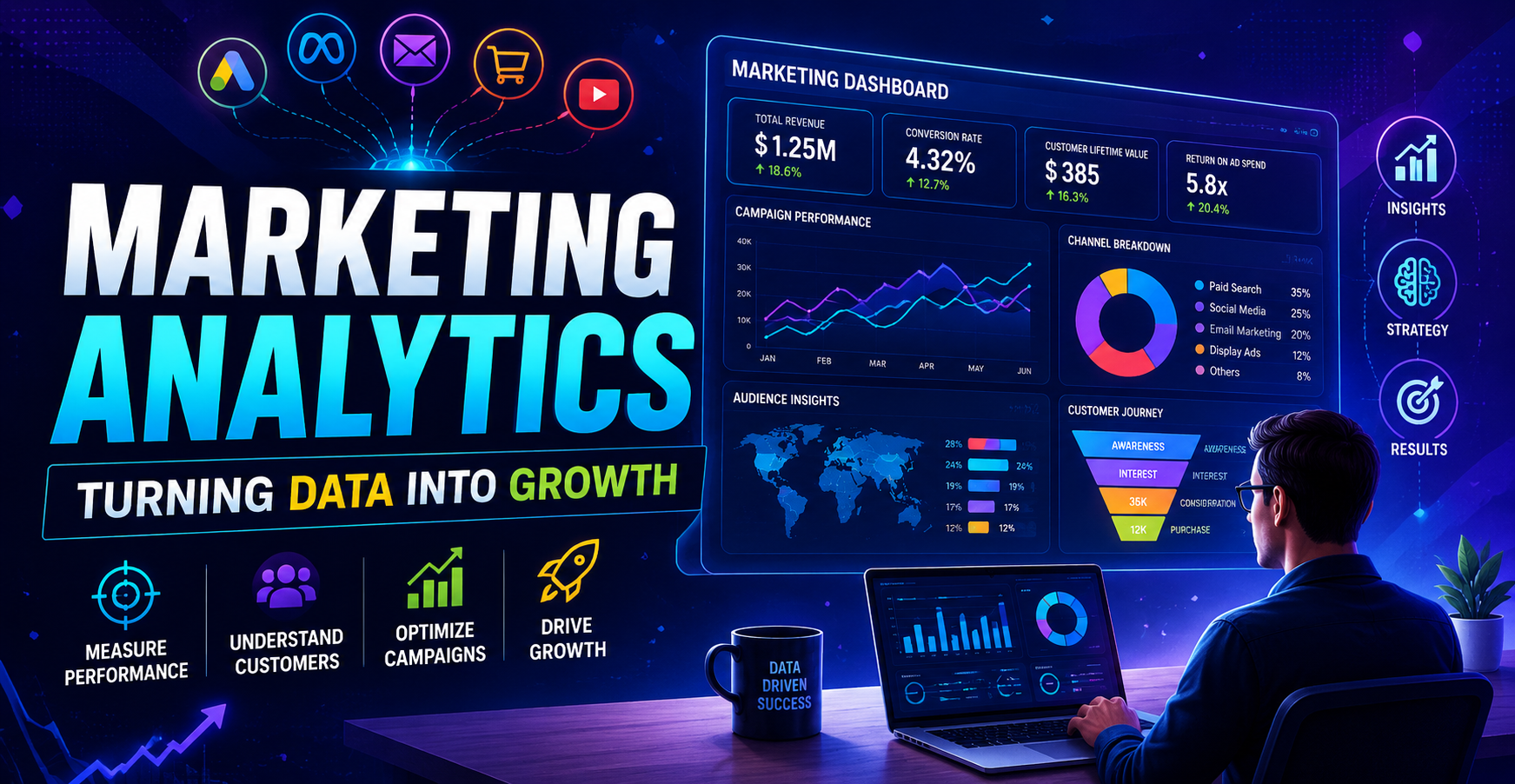
Marketing Analytics: The Complete Guide for Students to Master Data-Driven Marketing
In today's digital-first world, marketing is no longer based on assumptions or guesswork. Businesses rely heavily on data to understand customer behavior, measure campaign performance, and make informed decisions. This is where Marketing Analytics plays a crucial role.
Marketing Analytics has become one of the most valuable skills in the digital marketing industry. Companies use analytics to track website visitors, analyze customer journeys, measure advertising performance, optimize marketing budgets, and increase return on investment (ROI).
Whether you aspire to become a Digital Marketing Specialist, SEO Executive, Social Media Manager, Performance Marketer, Data Analyst, or Marketing Manager, understanding marketing analytics is essential for building a successful career.
In this comprehensive guide, we will explore Marketing Analytics, its importance, tools, metrics, career opportunities, and how students can develop expertise in this rapidly growing field.
What is Marketing Analytics?
Marketing Analytics is the process of collecting, measuring, analyzing, and interpreting marketing data to improve business performance and marketing effectiveness.
It helps marketers answer critical questions such as:
- Which marketing channel generates the most leads?
- What is the return on advertising spend?
- Which campaigns are driving sales?
- How do customers interact with a website?
- What content performs best?
- Which audience segments are most valuable?
By analyzing data, businesses can make smarter marketing decisions and achieve better results.
Simple Definition
Marketing Analytics refers to using data and analytical techniques to evaluate marketing performance and optimize future marketing strategies.
Why Marketing Analytics is Important
Modern businesses generate enormous amounts of customer and campaign data every day.
Without analytics, companies cannot effectively understand:
- Customer preferences
- User behavior
- Campaign effectiveness
- Website performance
- Marketing ROI
Marketing Analytics transforms raw data into actionable insights.
Benefits of Marketing Analytics
Better Decision Making
Analytics helps marketers make decisions based on facts rather than assumptions.
Improved ROI
Businesses can allocate budgets to the highest-performing channels.
Enhanced Customer Understanding
Analytics reveals customer interests, behaviors, and purchasing patterns.
Competitive Advantage
Companies using analytics often outperform competitors by identifying opportunities faster.
Campaign Optimization
Real-time insights help marketers adjust campaigns for better results.
The Evolution of Marketing Analytics
Marketing analytics has evolved significantly over the years.
Traditional Marketing Analytics
Earlier methods focused on:
- Surveys
- Customer feedback
- Sales reports
- Focus groups
While useful, these methods provided limited insights.
Digital Marketing Analytics
Today marketers track:
- Website traffic
- User interactions
- Social media engagement
- Advertising performance
- Email campaigns
- Customer journeys
Modern analytics tools provide real-time insights and advanced reporting capabilities.
AI-Powered Analytics
Artificial Intelligence is transforming marketing analytics through:
- Predictive analysis
- Customer segmentation
- Automated reporting
- Behavioral forecasting
- Marketing automation
AI-driven analytics is becoming one of the biggest trends in digital marketing.
Types of Marketing Analytics
Understanding different types of analytics helps marketers interpret data effectively.
Descriptive Analytics
Descriptive analytics explains what happened.
Examples include:
- Website visitors last month
- Number of leads generated
- Social media engagement rates
Diagnostic Analytics
Diagnostic analytics explains why something happened.
Examples include:
- Why traffic dropped
- Why conversion rates increased
- Why customers abandoned carts
Predictive Analytics
Predictive analytics forecasts future outcomes.
Examples include:
- Predicting customer purchases
- Forecasting sales trends
- Identifying high-value leads
Prescriptive Analytics
Prescriptive analytics recommends actions.
Examples include:
- Best advertising strategy
- Optimal marketing budget allocation
- Recommended customer targeting approaches
Key Components of Marketing Analytics
Successful marketing analytics involves several interconnected elements.
Data Collection
Businesses gather data from:
- Websites
- Mobile applications
- Social media platforms
- CRM systems
- Email marketing tools
- Advertising platforms
Data Processing
Collected data is cleaned and organized for analysis.
Data Analysis
Marketers use analytical methods to identify patterns and trends.
Reporting
Insights are presented through reports and dashboards.
Decision Making
Organizations use insights to improve marketing strategies.
Important Marketing Analytics Metrics
Every digital marketer should understand key performance indicators (KPIs).
Website Traffic
Measures the number of visitors visiting a website.
Important traffic metrics include:
- Total users
- New users
- Returning visitors
- Page views
Bounce Rate
Bounce rate measures the percentage of visitors who leave a website without taking further action.
Lower bounce rates often indicate better user engagement.
Conversion Rate
Conversion rate measures how many visitors complete desired actions.
Examples include:
- Form submissions
- Purchases
- Newsletter sign-ups
- Course registrations
Click-Through Rate (CTR)
CTR measures the percentage of users who click on an advertisement, email, or link.
Customer Acquisition Cost (CAC)
CAC calculates how much it costs to acquire a new customer.
Return on Investment (ROI)
ROI evaluates the profitability of marketing campaigns.
Customer Lifetime Value (CLV)
CLV estimates the total revenue generated by a customer throughout their relationship with a business.
Marketing Analytics in SEO
Search Engine Optimization relies heavily on analytics.
SEO professionals analyze:
- Organic traffic
- Keyword rankings
- Search visibility
- User engagement
- Backlink performance
Key SEO Metrics
Organic Traffic
Measures visitors arriving through search engines.
Keyword Rankings
Tracks positions of target keywords in search results.
Average Session Duration
Indicates how long visitors stay on a website.
Pages Per Session
Measures user engagement and website navigation effectiveness.
Analytics helps SEO professionals continuously improve search performance.
Marketing Analytics in Social Media
Social media platforms provide extensive analytical insights.
Marketers track:
- Reach
- Impressions
- Engagement
- Shares
- Comments
- Followers
- Video views
Social Media KPIs
Engagement Rate
Measures audience interaction with content.
Reach
Shows how many people viewed content.
Impressions
Represents total content views.
Audience Growth
Tracks follower increases over time.
These insights help marketers create more effective social media strategies.
Marketing Analytics in Paid Advertising
Paid advertising generates large amounts of performance data.
Platforms such as Google Ads and social media advertising platforms provide detailed reports.
Important Advertising Metrics
Cost Per Click (CPC)
The amount paid for each ad click.
Cost Per Acquisition (CPA)
The cost required to generate a conversion.
Return on Ad Spend (ROAS)
Measures revenue generated for every advertising dollar spent.
Conversion Tracking
Helps marketers understand which campaigns drive business results.
Analytics ensures advertising budgets are spent efficiently.
Marketing Analytics in Email Marketing
Email marketing remains one of the highest ROI marketing channels.
Analytics helps evaluate campaign performance.
Important Email Metrics
Open Rate
Percentage of recipients opening emails.
Click Rate
Percentage of users clicking email links.
Conversion Rate
Measures actions completed after opening emails.
Unsubscribe Rate
Tracks users opting out of email lists.
These insights help marketers improve email effectiveness.
Popular Marketing Analytics Tools
Modern marketers use specialized tools to collect and analyze data.
Google Analytics
One of the most widely used website analytics platforms.
It helps track:
- Website traffic
- User behavior
- Conversions
- Customer journeys
Google Search Console
Provides insights into search performance and keyword visibility.
Google Looker Studio
Creates visual dashboards and reports.
Microsoft Clarity
Offers user behavior analysis through:
- Heatmaps
- Session recordings
- User interaction tracking
HubSpot Analytics
Combines marketing, sales, and CRM analytics.
SEMrush
Provides SEO and competitive analysis insights.
Ahrefs
Popular for backlink analysis and keyword research.
Students should gain hands-on experience with these tools to strengthen their digital marketing skills.
The Role of AI in Marketing Analytics
Artificial Intelligence is revolutionizing analytics.
AI can:
- Analyze large datasets quickly
- Predict customer behavior
- Automate reports
- Detect patterns
- Improve targeting accuracy
AI-Powered Marketing Applications
Predictive Customer Analysis
Forecasts future customer actions.
Personalized Marketing
Delivers customized experiences to users.
Automated Insights
AI identifies trends without manual analysis.
Smart Campaign Optimization
AI adjusts campaigns for better performance.
AI-powered analytics is expected to dominate digital marketing in the coming years.
Data Visualization in Marketing Analytics
Raw data can be difficult to interpret.
Data visualization converts information into:
- Charts
- Graphs
- Dashboards
- Reports
Benefits of Data Visualization
Faster Understanding
Visual representations simplify complex data.
Better Communication
Teams can easily share insights.
Improved Decision Making
Decision-makers quickly identify trends and opportunities.
Visualization is a key skill for marketing analysts.
Challenges in Marketing Analytics
While analytics offers many benefits, challenges exist.
Data Quality Issues
Incomplete or inaccurate data can affect insights.
Privacy Regulations
Organizations must comply with data protection laws.
Multiple Data Sources
Integrating data from various platforms can be complex.
Skill Gaps
Many marketers struggle with data interpretation and analytical thinking.
Continuous learning helps professionals overcome these challenges.
Career Opportunities in Marketing Analytics
The demand for analytics professionals continues to grow globally.
Digital Marketing Analyst
Analyzes campaign performance and marketing data.
Marketing Data Analyst
Interprets customer and business data.
SEO Analyst
Uses analytics to improve search engine rankings.
Performance Marketing Specialist
Focuses on paid advertising optimization.
Web Analytics Specialist
Tracks website performance and user behavior.
Growth Marketing Manager
Uses data-driven strategies to drive business growth.
Marketing Manager
Leverages analytics for strategic decision-making.
These roles offer excellent career growth opportunities for students.
Skills Required for a Career in Marketing Analytics
Students should develop both technical and analytical skills.
Analytical Thinking
Ability to interpret data and identify patterns.
Data Interpretation
Understanding marketing reports and KPIs.
Excel and Spreadsheet Skills
Useful for data organization and analysis.
SEO Knowledge
Understanding search engine performance metrics.
Advertising Analytics
Analyzing PPC and social media campaign performance.
Data Visualization
Creating dashboards and reports.
AI and Automation Knowledge
Understanding AI-driven analytics tools.
Communication Skills
Explaining insights clearly to stakeholders.
These skills make candidates highly attractive to employers.
How Students Can Learn Marketing Analytics
Students can begin their learning journey through structured training and practical experience.
Learn Digital Marketing Fundamentals
Understand:
- SEO
- PPC Advertising
- Social Media Marketing
- Content Marketing
- Email Marketing
Master Analytics Tools
Gain hands-on experience with:
- Google Analytics
- Search Console
- Looker Studio
- SEMrush
- Ahrefs
Work on Real Projects
Apply analytics concepts to websites and marketing campaigns.
Build a Portfolio
Showcase dashboards, reports, and campaign analyses.
Earn Certifications
Industry-recognized certifications help demonstrate expertise.
Practical experience combined with theoretical knowledge creates strong career opportunities.
Future of Marketing Analytics
The future of marketing analytics is increasingly data-driven and AI-powered.
Emerging trends include:
- Predictive Analytics
- AI-Based Decision Making
- Real-Time Reporting
- Customer Journey Analytics
- Marketing Automation
- Advanced Personalization
- Privacy-Focused Analytics
Organizations will continue investing in analytics to improve customer experiences and maximize business growth.
Students who develop analytics skills today will be well-positioned for the future digital economy.
Conclusion
Marketing Analytics has become the foundation of successful digital marketing strategies. It enables businesses to understand customers, measure campaign effectiveness, optimize marketing investments, and drive sustainable growth.
For students pursuing careers in Digital Marketing, Data Analytics, AI, Business Intelligence, and Marketing Management, mastering marketing analytics is no longer optional—it is a necessity. The ability to collect, analyze, and interpret data is one of the most valuable skills in today's competitive job market.
By learning analytics tools, understanding key marketing metrics, and developing data-driven thinking, students can build rewarding careers and become highly sought-after professionals in the digital marketing industry.