


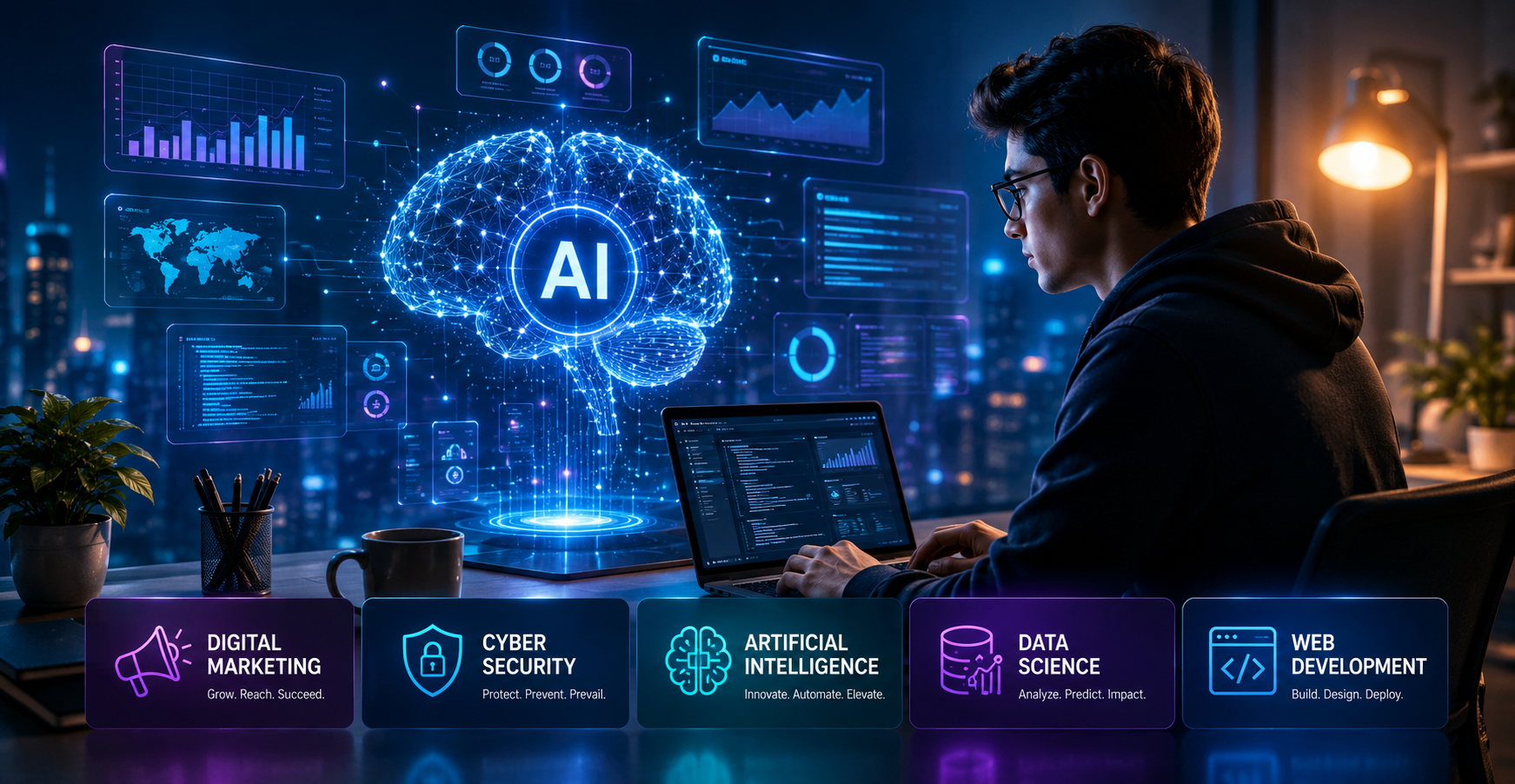
AI Trends 2026: The Future of Artificial Intelligence Every Student Should Know
Artificial Intelligence (AI) is no longer a futuristic concept—it has become an essential part of our daily lives, businesses, education systems, and digital ecosystems. From AI-powered chatbots and virtual assistants to autonomous systems and advanced data analytics, AI continues to reshape industries at an unprecedented pace.
As we move through 2026, artificial intelligence is entering a new phase of innovation. Organizations across the world are investing heavily in AI technologies to improve productivity, automate repetitive tasks, strengthen cybersecurity, personalize customer experiences, and accelerate decision-making. For students aspiring to build careers in Digital Marketing, Cyber Security, Data Science, Machine Learning, Software Development, and AI Engineering, understanding the latest AI trends is crucial.
This blog explores the most important AI trends in 2026, their impact on various industries, and the skills students should develop to stay competitive in the rapidly evolving job market.
Why AI Matters More Than Ever in 2026
AI has evolved from being a supporting technology to becoming a strategic business asset. Companies are increasingly relying on AI to analyze massive amounts of data, automate workflows, predict outcomes, and create intelligent customer experiences.
Several factors are driving AI adoption:
- Increasing availability of data
- Advancements in machine learning algorithms
- Growth of cloud computing infrastructure
- Rising demand for automation
- Improved access to AI tools and platforms
- Integration of AI into everyday software applications
As a result, AI-related skills are among the most in-demand competencies in the global workforce.
Generative AI Continues to Transform Industries
Generative AI remains one of the most influential AI trends in 2026. These systems can create text, images, videos, music, code, and even business strategies based on user prompts.
Businesses are using Generative AI for:
- Content creation
- Marketing campaigns
- Customer support
- Software development
- Product design
- Data analysis
- Research assistance
For students, Generative AI tools are becoming powerful learning companions that can help with:
- Coding practice
- Research summaries
- Language learning
- Project development
- Content generation
- Interview preparation
However, organizations are also focusing on responsible AI usage to ensure accuracy, transparency, and ethical implementation.
Popular Applications of Generative AI
Content Marketing
Marketers use AI to generate blogs, social media posts, ad copies, email campaigns, and SEO content.
Software Development
AI coding assistants help developers write, debug, and optimize code faster than ever before.
Education
AI tutors provide personalized learning experiences, helping students understand complex concepts at their own pace.
AI Agents Become Mainstream
One of the biggest developments in 2026 is the rise of AI agents.
Unlike traditional chatbots, AI agents can:
- Understand complex instructions
- Perform multi-step tasks
- Make decisions based on objectives
- Interact with multiple applications
- Automate business processes
For example, an AI agent can:
- Research a topic
- Create a report
- Generate presentation slides
- Schedule meetings
- Send emails
All with minimal human intervention.
Businesses are adopting AI agents to improve productivity and reduce operational costs. Students entering the workforce will increasingly collaborate with AI agents rather than simply using software tools.
Multimodal AI Becomes the New Standard
Earlier AI systems primarily processed text. Modern AI systems can understand and generate multiple forms of data simultaneously.
This capability is known as Multimodal AI.
Multimodal AI can process:
- Text
- Images
- Videos
- Audio
- Documents
- Real-world sensor data
For example, a user can upload an image and ask questions about it, provide voice instructions, and receive visual outputs.
Benefits of Multimodal AI
Better User Experience
Users can interact naturally using different formats.
Enhanced Business Applications
Organizations can analyze customer interactions, images, videos, and text together for deeper insights.
Improved Learning Tools
Students can learn through visual, textual, and interactive content generated by AI systems.
AI-Powered Cybersecurity Gains Importance
As cyber threats become more sophisticated, organizations are increasingly using AI for cybersecurity.
AI helps security teams:
- Detect anomalies
- Identify threats faster
- Monitor network activity
- Prevent fraud
- Analyze malware
- Respond to incidents automatically
How AI is Transforming Cyber Security
Real-Time Threat Detection
AI systems can identify suspicious activities immediately, reducing response times.
Behavioral Analytics
Machine learning algorithms can detect unusual user behavior that may indicate cyberattacks.
Automated Security Operations
AI automates repetitive security tasks, allowing cybersecurity professionals to focus on critical threats.
For students interested in Cyber Security, learning AI-driven security tools is becoming an essential skill.
Explainable AI (XAI) Gains Momentum
As AI systems become more powerful, organizations want greater transparency in AI decision-making.
Explainable AI focuses on making AI systems understandable and trustworthy.
Businesses need to know:
- Why an AI system made a decision
- Which factors influenced outcomes
- Whether biases exist in models
Why Explainable AI Matters
Regulatory Compliance
Many industries require transparency in AI-driven decisions.
Increased Trust
Users are more likely to adopt AI when they understand how it works.
Better Decision-Making
Organizations can identify errors and improve model performance.
Explainable AI is expected to become a major area of research and implementation throughout 2026.
AI and Digital Marketing: A Powerful Combination
Digital marketing is experiencing a major transformation due to AI technologies.
Modern marketers use AI for:
- Keyword research
- Content creation
- Audience targeting
- Ad optimization
- Customer segmentation
- Performance analysis
AI Trends in Digital Marketing
Hyper-Personalization
AI analyzes customer behavior to deliver highly personalized experiences.
Predictive Analytics
Marketers can forecast customer actions and optimize campaigns accordingly.
Automated Content Creation
AI tools assist with creating blogs, emails, social media posts, and advertisements.
Conversational Marketing
AI-powered chatbots and virtual assistants provide instant customer support and engagement.
Students pursuing Digital Marketing courses should learn how AI tools integrate with SEO, PPC advertising, content marketing, and social media management.
AI-Powered Search is Changing SEO
Search engines are becoming increasingly AI-driven.
Instead of simply matching keywords, AI-powered search engines focus on:
- User intent
- Context
- Natural language understanding
- Personalized results
What This Means for SEO
High-Quality Content Matters More
Search engines prioritize useful, authoritative, and well-structured content.
Topic Authority Becomes Essential
Websites need comprehensive content clusters around specific topics.
User Experience Impacts Rankings
Fast-loading pages, mobile responsiveness, and engaging content contribute to better rankings.
Conversational Search Growth
Users increasingly ask questions in natural language rather than typing short keyword phrases.
SEO professionals must adapt their strategies to align with AI-powered search experiences.
Edge AI Expands Rapidly
Edge AI involves processing AI tasks directly on devices rather than relying entirely on cloud servers.
Examples include:
- Smartphones
- Smart cameras
- IoT devices
- Wearable technology
- Autonomous vehicles
Advantages of Edge AI
Faster Processing
Data is analyzed locally, reducing latency.
Improved Privacy
Sensitive data remains on the device.
Reduced Cloud Dependency
Organizations save bandwidth and infrastructure costs.
Edge AI is expected to become increasingly important as connected devices continue to grow worldwide.
AI in Education Reaches New Heights
Education is one of the sectors experiencing significant AI-driven transformation.
AI technologies are making learning more personalized, interactive, and accessible.
Applications of AI in Education
Personalized Learning
AI adapts content based on student performance and learning styles.
Virtual Tutors
Students receive instant assistance and explanations.
Automated Assessments
AI helps educators evaluate assignments efficiently.
Learning Analytics
Educational institutions gain insights into student progress and engagement.
Students who understand how to effectively collaborate with AI tools can enhance their learning outcomes significantly.
Responsible AI and Ethical Development
As AI adoption increases, ethical concerns continue to receive attention.
Key areas include:
- Data privacy
- Bias mitigation
- Transparency
- Accountability
- Fairness
- Security
Organizations are implementing Responsible AI frameworks to ensure technologies are developed and deployed ethically.
Important Ethical Challenges
Algorithmic Bias
AI systems can inherit biases from training data.
Privacy Concerns
Protecting user information remains a top priority.
Misinformation Risks
AI-generated content must be monitored for accuracy and authenticity.
Students entering AI-related fields should understand both technical and ethical dimensions of artificial intelligence.
AI and Automation Reshape the Workforce
Automation continues to transform how businesses operate.
While some repetitive tasks are being automated, new job opportunities are emerging in:
- AI Engineering
- Machine Learning
- Data Science
- Prompt Engineering
- AI Product Management
- Cyber Security
- AI Governance
- AI Operations
Skills That Will Be Highly Valuable
Critical Thinking
Human judgment remains essential for complex decision-making.
Data Literacy
Understanding data is becoming a universal workplace skill.
AI Tool Proficiency
Professionals must know how to effectively use AI platforms.
Communication Skills
Explaining AI insights to stakeholders is increasingly important.
The future workforce will consist of humans and AI systems working together rather than AI replacing humans entirely.
Small Businesses Embrace AI Solutions
Previously, advanced AI tools were accessible mainly to large enterprises.
In 2026, affordable AI solutions allow startups and small businesses to benefit from:
- Marketing automation
- Customer support automation
- Sales optimization
- Predictive analytics
- Content creation
This democratization of AI creates new opportunities for entrepreneurs and digital professionals.
AI Infrastructure and Computing Innovations
Growing AI adoption requires powerful computing infrastructure.
Major advancements include:
- Specialized AI chips
- High-performance GPUs
- Energy-efficient processors
- Advanced cloud AI platforms
These technologies enable organizations to train and deploy increasingly sophisticated AI models.
Students interested in AI engineering should familiarize themselves with cloud platforms, machine learning frameworks, and AI deployment techniques.
Career Opportunities in AI for Students
The demand for AI professionals continues to rise across industries.
Popular career paths include:
AI Engineer
Designs and develops intelligent systems.
Machine Learning Engineer
Builds predictive models and AI applications.
Data Scientist
Extracts insights from large datasets.
AI Research Scientist
Advances AI technologies through research.
AI Product Manager
Coordinates AI product development and strategy.
AI Security Specialist
Protects AI systems from cyber threats.
Prompt Engineer
Optimizes interactions with generative AI systems.
Students who combine AI knowledge with domain expertise in marketing, cybersecurity, finance, healthcare, or software development can unlock even greater career opportunities.
How Students Can Prepare for the AI Future
To stay competitive in the AI-driven economy, students should focus on continuous learning.
Learn Core Concepts
Understand:
- Machine Learning
- Deep Learning
- Neural Networks
- Natural Language Processing
- Computer Vision
Develop Practical Skills
Work on:
- AI projects
- Hackathons
- Internships
- Open-source contributions
Master AI Tools
Gain hands-on experience with popular AI platforms and productivity tools.
Strengthen Programming Knowledge
Languages such as Python remain highly valuable in AI development.
Build a Portfolio
Showcase projects that demonstrate real-world AI applications and problem-solving abilities.
Conclusion
AI Trends 2026 demonstrate that artificial intelligence is becoming deeply integrated into every aspect of modern life and business. From Generative AI and AI agents to cybersecurity automation, personalized education, multimodal systems, and responsible AI practices, the technology continues to evolve rapidly.
For students pursuing careers in Digital Marketing, Cyber Security, Artificial Intelligence, Data Science, and Software Development, now is the ideal time to develop AI-related skills. Organizations are actively seeking professionals who can understand, implement, and manage AI-powered solutions.
The future belongs to individuals who can effectively combine human creativity, critical thinking, and problem-solving abilities with the power of artificial intelligence. By staying informed about emerging AI trends and continuously upgrading their skills, students can position themselves for success in one of the most exciting technological eras in history.