


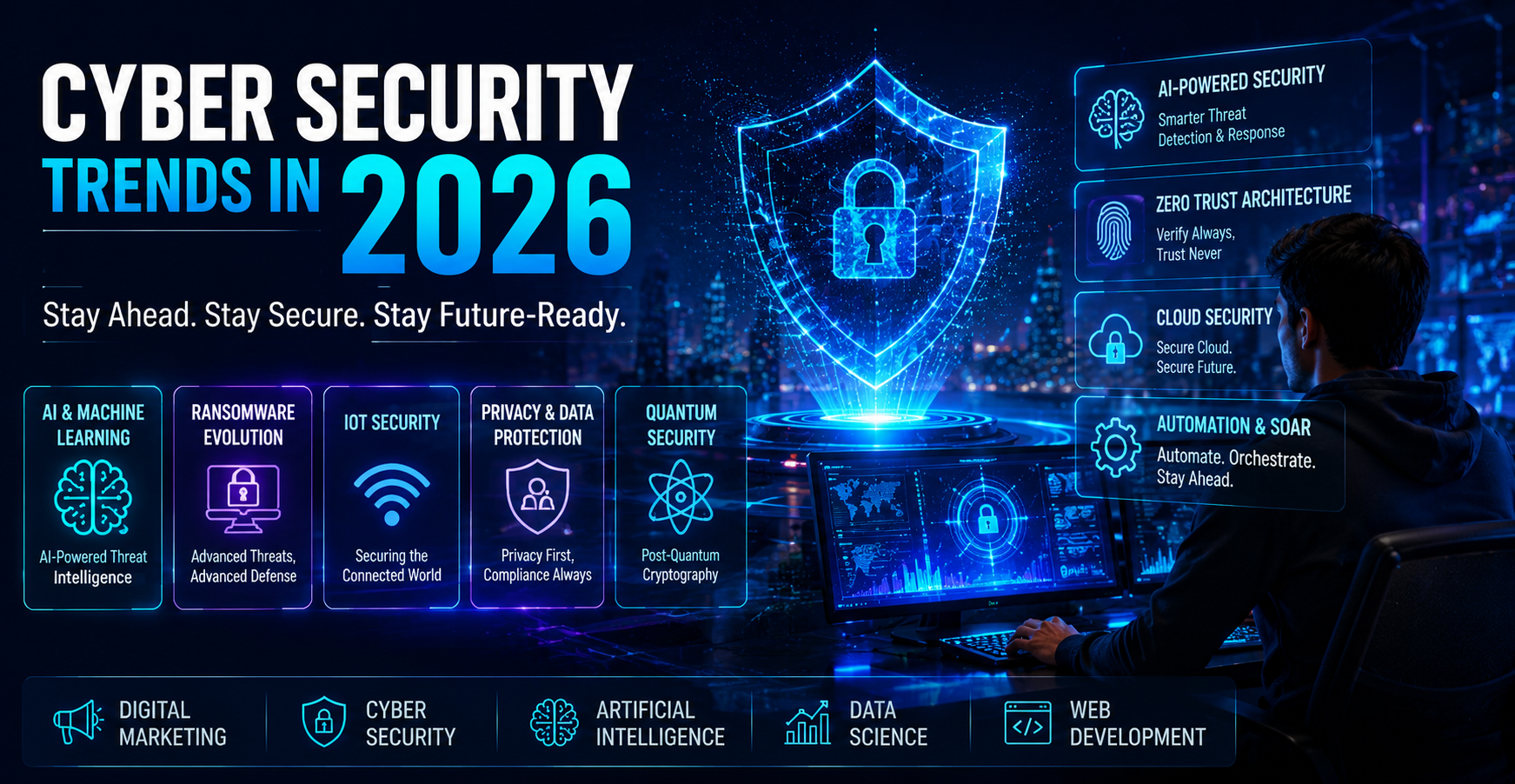
Cyber Security Trends in 2026: Future Technologies, Threats, and Career Opportunities
Cyber security is becoming one of the most important fields in the modern digital world. As businesses, governments, educational institutions, and individuals continue to rely heavily on technology, the need for advanced cyber security solutions is growing rapidly. In 2026, cyber threats are becoming more sophisticated due to advancements in Artificial Intelligence (AI), cloud computing, automation, and connected devices.
From ransomware attacks and AI-powered hacking to cloud security and zero trust architecture, cyber security trends are evolving faster than ever. Companies are investing heavily in cyber defense systems, ethical hacking, cybersecurity certifications, and AI-driven threat detection tools to protect sensitive information and digital infrastructure.
For students interested in cyber security careers, understanding the latest cyber security trends in 2026 is extremely important. The demand for skilled cyber security professionals is increasing globally, creating excellent career opportunities in ethical hacking, network security, cloud security, penetration testing, digital forensics, and AI security.
In this blog, you will learn about the top cyber security trends in 2026, emerging technologies, career opportunities, required skills, and how AI is transforming the cyber security industry.
Why Cyber Security is More Important Than Ever in 2026
Digital transformation has connected almost every industry to the internet. Businesses now store huge amounts of customer data online, while cloud computing and remote work have increased cyber risks significantly.
Cyber criminals are using advanced technologies to launch:
- Phishing attacks
- Ransomware attacks
- AI-powered cyber attacks
- Identity theft
- Cloud breaches
- Social engineering attacks
- IoT device hacking
At the same time, governments are introducing stricter data privacy regulations and cyber security compliance rules. Organizations are under pressure to strengthen their cyber defenses and hire skilled cyber security professionals.
This has made cyber security one of the fastest-growing industries globally.
AI-Powered Cyber Attacks
Artificial Intelligence is transforming both cyber defense and cyber attacks. In 2026, hackers are increasingly using AI tools to automate attacks and exploit vulnerabilities faster.
How AI is Used in Cyber Attacks
Cyber criminals are using AI for:
- Automated phishing emails
- Password cracking
- Malware development
- Deepfake scams
- AI-generated social engineering attacks
- Vulnerability scanning
AI can analyze huge amounts of data quickly, making attacks more personalized and difficult to detect.
AI in Cyber Defense
Fortunately, cyber security experts are also using AI to improve defense systems.
AI-powered cyber security tools can:
- Detect unusual network activity
- Identify malware patterns
- Predict cyber threats
- Automate threat responses
- Monitor user behavior
AI-based security systems are becoming essential for modern businesses.
Rise of Zero Trust Security Architecture
Zero Trust Security is one of the biggest cyber security trends in 2026.
Traditional security systems trusted users inside the network. However, modern cyber threats can bypass internal systems easily. Zero Trust Architecture works on the principle of:
“Never trust, always verify.”
Key Features of Zero Trust Security
- Multi-factor authentication (MFA)
- Continuous user verification
- Least privilege access
- Device authentication
- Network segmentation
Zero Trust security helps organizations reduce insider threats and unauthorized access.
Why Students Should Learn Zero Trust
Many companies are adopting Zero Trust frameworks, creating high demand for professionals skilled in:
- Identity management
- Access control
- Network security
- Cloud security
Learning Zero Trust concepts can improve career opportunities in cyber security.
Cloud Security Becomes a Top Priority
Cloud computing continues to dominate business operations in 2026. Companies are using platforms like:
- Amazon Web Services (AWS)
- Microsoft Azure
- Google Cloud Platform
However, cloud environments are becoming major targets for cyber attacks.
Common Cloud Security Threats
- Misconfigured cloud settings
- Data breaches
- Unauthorized access
- API vulnerabilities
- Insider threats
Cloud Security Solutions
Organizations are investing in:
- Cloud encryption
- Identity and access management (IAM)
- Cloud monitoring tools
- Secure cloud backups
- AI-powered threat detection
Career Opportunities in Cloud Security
Students with cloud security skills are highly valuable in the job market.
Popular certifications include:
- AWS Security Certification
- Microsoft Azure Security Engineer
- Certified Cloud Security Professional (CCSP)
Cloud security experts are among the highest-paid IT professionals in 2026.
Growth of Ethical Hacking and Penetration Testing
Ethical hacking is becoming increasingly important as companies proactively test their systems against cyber attacks.
Ethical hackers identify vulnerabilities before malicious hackers can exploit them.
What Ethical Hackers Do
Ethical hackers perform:
- Penetration testing
- Vulnerability assessment
- Security audits
- Web application testing
- Network security testing
Popular Ethical Hacking Tools
- Metasploit
- Burp Suite
- Nmap
- Wireshark
- Kali Linux
Ethical Hacking Career Demand
Companies across industries need ethical hackers to secure their systems.
Students searching for:
- Ethical hacking courses
- Penetration testing certifications
- Cyber security jobs for beginners
will find strong career opportunities in this field.
Ransomware Attacks Continue to Increase
Ransomware remains one of the biggest cyber threats in 2026.
In ransomware attacks, hackers encrypt company data and demand payment to restore access.
Why Ransomware is Growing
- Increased remote work
- Weak passwords
- Phishing attacks
- Poor backup systems
- Unpatched software vulnerabilities
Industries Targeted by Ransomware
- Healthcare
- Banking
- Education
- Government organizations
- eCommerce businesses
Ransomware Prevention Techniques
Organizations are improving security through:
- Regular data backups
- Employee training
- Endpoint protection
- Email security
- Multi-factor authentication
Cyber security professionals specializing in ransomware prevention are highly demanded.
Internet of Things (IoT) Security Challenges
Smart devices and IoT technology are expanding rapidly.
Examples include:
- Smart home devices
- Wearable technology
- Smart cameras
- Industrial IoT systems
- Connected healthcare devices
However, many IoT devices have weak security systems.
Common IoT Security Risks
- Weak passwords
- Lack of encryption
- Unsecured networks
- Outdated firmware
- Unauthorized access
IoT Security Solutions
Cyber security companies are developing:
- Secure IoT frameworks
- Device authentication systems
- AI-powered IoT monitoring
- Network segmentation
IoT security is becoming an important specialization in cyber security careers.
Cyber Security Automation
Automation is helping organizations manage cyber threats more efficiently.
Benefits of Security Automation
- Faster threat detection
- Reduced human error
- Automated incident response
- Improved security monitoring
- Better scalability
Security Operations Center (SOC) Automation
SOC teams use automation tools for:
- Log analysis
- Threat intelligence
- Malware detection
- Security alerts
Automation allows cyber security teams to focus on complex threats.
Skills Students Should Learn
Students should learn:
- SIEM tools
- Threat intelligence platforms
- Security scripting
- AI-based security automation
Automation skills increase employability in cyber security jobs.
Deepfake and Social Engineering Attacks
AI-generated deepfake technology is becoming a major cyber threat.
Deepfakes can create fake:
- Videos
- Voice recordings
- Images
- Identity impersonations
Social Engineering in 2026
Hackers manipulate human psychology to steal information through:
- Fake emails
- Fraudulent calls
- Deepfake videos
- Fake job offers
How to Prevent Social Engineering
Organizations are focusing on:
- Cyber awareness training
- Identity verification systems
- AI-powered fraud detection
Students should understand social engineering because human error remains a major security weakness.
Data Privacy and Compliance Regulations
Governments worldwide are strengthening data privacy laws.
Companies must protect customer data and follow compliance regulations.
Popular Cyber Security Regulations
- GDPR
- CCPA
- HIPAA
- PCI DSS
Why Compliance Matters
Failure to comply can lead to:
- Heavy fines
- Reputation damage
- Legal consequences
- Data breach risks
Cyber security professionals with compliance knowledge are highly valuable.
Cyber Security Skills in High Demand in 2026
The cyber security industry requires professionals with specialized technical and analytical skills.
Technical Skills
Students should learn:
- Network security
- Ethical hacking
- Cloud security
- Malware analysis
- Digital forensics
- Linux fundamentals
- Programming basics
- Penetration testing
Soft Skills
Cyber security also requires:
- Problem-solving
- Analytical thinking
- Communication skills
- Attention to detail
- Risk assessment
Combining technical and soft skills improves career success.
Top Cyber Security Certifications for Students
Cyber security certifications help students validate their skills and improve job opportunities.
Beginner-Level Certifications
- CompTIA Security+
- Certified Ethical Hacker (CEH)
- Google Cybersecurity Certificate
Advanced Certifications
- CISSP
- OSCP
- CISM
- CCSP
These certifications are recognized globally and improve career growth.
Cyber Security Career Opportunities in 2026
The cyber security industry offers excellent career opportunities with high salaries and job stability.
Popular Cyber Security Job Roles
Ethical Hacker
Tests systems for vulnerabilities and security weaknesses.
Security Analyst
Monitors networks and investigates cyber threats.
Cloud Security Engineer
Protects cloud-based systems and applications.
Penetration Tester
Simulates cyber attacks to improve security.
SOC Analyst
Works in Security Operations Centers to monitor threats.
Cyber Security Consultant
Advises businesses on security strategies and risk management.
Industries Hiring Cyber Security Professionals
- IT companies
- Banks
- Healthcare organizations
- Government agencies
- Educational institutions
- eCommerce businesses
Cyber security jobs are expected to continue growing rapidly in the coming years.
Role of AI in Future Cyber Security Careers
AI is changing how cyber security professionals work.
AI-Based Threat Detection
AI systems analyze:
- User behavior
- Network traffic
- Malware patterns
- Security logs
This helps identify threats faster.
AI and Ethical Hacking
AI tools assist ethical hackers by:
- Automating vulnerability scans
- Detecting anomalies
- Improving penetration testing
Students who combine AI and cyber security skills will have strong career advantages.
Importance of Cyber Security Education
Cyber security awareness is essential for everyone, not just professionals.
Educational institutions are increasingly offering:
- Cyber security courses
- Ethical hacking training
- AI security programs
- Cloud security certifications
Benefits of Learning Cyber Security
- High-paying career opportunities
- Strong global demand
- Remote work opportunities
- Continuous learning
- Exciting technical challenges
Students interested in technology should seriously consider cyber security careers.
Best Platforms to Learn Cyber Security
Students can learn cyber security through:
- Online certification courses
- Practical labs
- Capture the Flag (CTF) competitions
- Internship programs
- Cyber security bootcamps
Hands-on practice is extremely important in cyber security learning.
Future of Cyber Security Beyond 2026
Cyber security will continue evolving with new technologies.
Future trends may include:
- Quantum computing security
- AI-powered autonomous defense systems
- Biometric security advancements
- Advanced threat intelligence
- Blockchain security solutions
As technology grows, cyber security will remain one of the most critical industries worldwide.
Conclusion
Cyber security trends in 2026 show that the digital world is becoming both more advanced and more vulnerable to cyber threats. AI-powered attacks, ransomware, cloud vulnerabilities, IoT risks, and deepfake scams are pushing organizations to strengthen their security systems rapidly.
At the same time, technologies like AI-driven threat detection, Zero Trust Architecture, cloud security solutions, and automation are transforming how businesses defend themselves against cyber attacks.
For students, this creates excellent opportunities to build successful careers in cyber security, ethical hacking, cloud security, penetration testing, and AI security. Learning modern cyber security skills, certifications, and practical tools can help students stay competitive in one of the fastest-growing industries in the world.
As businesses continue investing in cyber defense and digital protection, cyber security professionals will remain highly valuable in the global job market. Students who start learning cyber security today can become the future defenders of the digital world.