


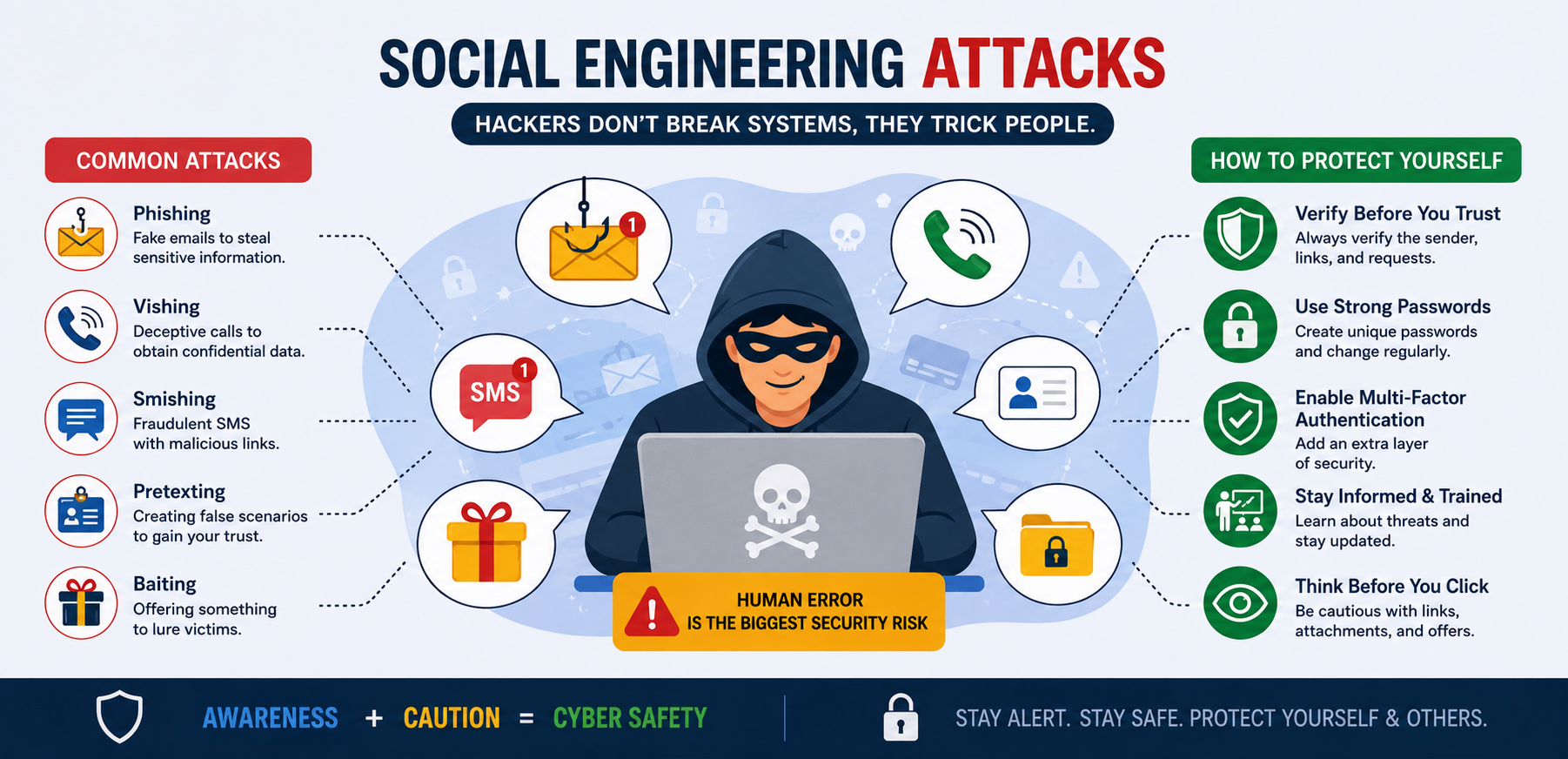
Social Engineering Attacks : The Human Side of Cybercrime Every Student Should Know About
We usually imagine hackers as highly skilled programmers sitting in dark rooms, breaking into systems using complex codes and advanced software. But in reality, many Cybercriminals don’t even need to hack systems anymore they simply hack people.
That’s exactly what Social Engineering Attacks are all about.
Instead of attacking computers directly, cybercriminals manipulate human emotions like fear, trust, curiosity, urgency, or greed to trick people into sharing sensitive information. Sometimes, a single click on a fake link or one careless reply to a message is enough for hackers to steal passwords, banking details, or even company data.
Today, almost everything happens online education, banking, shopping, social media, digital marketing, freelancing, and even job interviews. Because of this, cyber threats are increasing rapidly, especially social engineering scams.
Whether you are planning to build a career in Cyber Security, Digital Marketing, or Artificial Intelligence, understanding social engineering has become extremely important. Students searching for Cyber Security Courses in Navi Mumbai, Ethical Hacking Training, AI Courses, or Digital Marketing Courses should know how these attacks work because they affect almost every industry today.
In this blog, we’ll understand:
- What social engineering attacks are
- Why hackers use them
- Different types of attacks
- Real-life examples
- How to stay safe online
- Career opportunities in cyber security
Let’s begin.
What Are Social Engineering Attacks ?
Social engineering attacks are scams where cybercriminals manipulate people into revealing confidential information or performing unsafe actions.
In simple words, instead of breaking into systems forcefully, hackers trick people into giving them access willingly.
These attacks usually target:
- Passwords
- OTPs
- Bank details
- Company data
- Social media accounts
- Personal information
The scary part is that these attacks often look very real.
For example:
- A fake bank email asking you to verify your account
- A call from someone pretending to be customer support
- A message saying you’ve won a prize
- A fake job opportunity link
Many people fall for these tricks because attackers are experts at creating panic, trust, or excitement.
This is why social engineering is one of the most important topics taught in Ethical Hacking and Cyber Security Courses today.
Why Are Social Engineering Attacks Increasing So Fast ?
The internet has become a huge part of our daily lives. We constantly share information online without realizing how valuable it can be to cybercriminals.
Here are some major reasons why social engineering attacks are growing rapidly.
- People Share Too Much Online
From birthdays and phone numbers to workplace details and travel photos, people share a lot on social media.
Hackers use this information to create personalized scams that look genuine.
For example:
If someone knows your college name, company, or favorite shopping app, they can create fake messages that appear trustworthy.
- Lack of Cyber Awareness
Many people still cannot identify:
- Fake emails
- Suspicious links
- Scam calls
- Fraudulent websites
This makes them easy targets.
Even educated users sometimes fall for well-designed phishing attacks.
- Remote Work and Online Learning
Since remote work and online education became common, people now depend heavily on emails, video calls, and online platforms.
Cybercriminals take advantage of this digital communication.
- AI-Powered Scams
Artificial Intelligence is making cyber scams smarter.
Hackers now use AI tools to create:
- Fake voice calls
- Deepfake videos
- Personalized scam emails
- Automated phishing campaigns
This is one reason why AI and Cyber Security Courses are becoming increasingly popular among students.
Different Types of Social Engineering Attacks
Let’s understand the most common types of social engineering attacks in a simple way.
- Phishing Attacks
Phishing is the most common social engineering attack.
In phishing, hackers send fake emails or messages pretending to be trusted companies or organizations.
The goal is to make victims:
- Click dangerous links
- Download malware
- Share passwords
- Enter banking details
Example:
You receive a message saying:
“Your bank account will be blocked within 24 hours. Click here to update your KYC.”
The link opens a fake banking website that steals your login credentials.
Phishing attacks are extremely common in banking, e-commerce, and digital marketing industries.
- Spear Phishing
Spear phishing is a more advanced and targeted form of phishing.
Instead of sending random messages to thousands of people, attackers first research their victim.
They collect information from:
- Company websites
Then they create personalized messages that look genuine.
Example:
A hacker sends an email pretending to be your college administrator or office manager asking for login credentials.
Because the message feels personal, victims are more likely to trust it.
- Vishing (Voice Phishing)
Vishing happens through phone calls.
Attackers pretend to be:
- Bank employees
- Government officers
- Customer care executives
- Technical support staff
They usually create fear or urgency.
Example:
“Your ATM card will be blocked immediately unless you verify your OTP.”
Many people panic and unknowingly share confidential details.
- Smishing (SMS Phishing)
Smishing attacks happen through SMS messages.
You may receive messages like:
- “Your parcel delivery failed”
- “Claim your reward now”
- “Your account has suspicious activity”
These messages usually contain malicious links.
Once clicked, they may install malware or redirect users to fake websites.
- Pretexting
In pretexting, attackers create fake stories or situations to gain trust.
Example:
Someone pretending to be from your company’s IT department may call and ask for your password to “fix a system issue.”
Because the situation sounds believable, people often cooperate.
- Baiting
Baiting attacks use tempting offers to attract victims.
Examples include:
- Free movie downloads
- Free software
- Fake giveaways
- USB drives left in public places
Once the victim interacts with the bait, malware gets installed on their device.
- Tailgating
Tailgating is a physical social engineering attack.
An unauthorized person enters a restricted area by following someone with authorized access.
Example:
A stranger carrying delivery boxes requests an employee to hold the office door open.
Without realizing it, the employee gives access to an intruder.
- Honey Trap Attacks
In honey trap attacks, cybercriminals build fake emotional or romantic relationships online.
They gain trust slowly and later manipulate victims for:
- Money
- Private information
- Sensitive photos
- Company data
These scams are increasingly common on social media and dating apps.
Real-Life Examples of Social Engineering Attacks
Social engineering attacks happen even to large companies and famous organizations.
- Twitter Bitcoin Scam
In 2020, hackers targeted employees of Twitter using social engineering techniques.
They gained access to internal systems and hijacked accounts of celebrities and business leaders.
Fake cryptocurrency posts were shared to scam users.
This incident proved that human error can compromise even large tech companies.
- Google and Facebook Invoice Scam
Cybercriminals tricked employees at Google and Facebook into transferring millions of dollars through fake invoices.
The emails looked authentic, which made the scam successful.
- COVID-19 Scam Campaigns
During the pandemic, hackers created fake:
- Vaccine registration portals
- Health advisories
- Relief fund messages
Fear and confusion made people more vulnerable to these scams.
How Hackers Manipulate Human Psychology ?
Social engineering attacks work because they exploit human emotions.
Let’s look at the common psychological tricks used by cybercriminals.
- Fear
Messages like:
- “Your account will be suspended”
- “Legal action will be taken”
- “Immediate payment required”
These create panic and stop people from thinking carefully.
- Urgency
Hackers pressure victims to act quickly.
Example:
“Limited-time offer” or “Respond within 10 minutes.”
People make mistakes when rushed.
- Trust
Attackers pretend to be trusted individuals like:
- Managers
- Teachers
- Bank officials
- Technical support staff
This increases the chances of cooperation.
- Curiosity
Humans naturally want to know exciting or secret information.
Examples:
- “Confidential salary report”
- “Your photos leaked online”
Curiosity often leads people to click dangerous links.
- Greed
Fake rewards, cashback offers, and lottery messages target people’s desire for quick benefits.
How Social Engineering Attacks Affect Businesses ?
Social engineering attacks can seriously damage businesses.
Financial Loss
Companies may lose money through:
- Fraudulent payments
- Data theft
- Ransomware attacks
Data Breaches
Hackers may steal:
- Customer data
- Employee records
- Financial information
- Confidential documents
Reputation Damage
Customers lose trust in businesses that fail to protect their information.
This can harm a company’s image for years.
Operational Problems
Cyber attacks can disrupt business operations and reduce productivity.
Many businesses now invest heavily in cyber security training because prevention is far cheaper than recovery.
How to Protect Yourself from Social Engineering Attacks ?
The good news is that most social engineering attacks can be prevented through awareness and smart online habits.
Always Verify Before Trusting
Before sharing sensitive information:
- Verify emails
- Double-check phone calls
- Confirm website links
Never trust urgent requests blindly.
Use Multi-Factor Authentication (MFA)
MFA adds extra security by requiring additional verification beyond passwords.
Even if hackers steal your password, they still cannot easily access your account.
Avoid Clicking Suspicious Links
Before clicking:
- Check the sender’s email address
- Look for spelling mistakes
- Verify website URLs carefully
Keep Devices Updated
Regular software updates fix security vulnerabilities.
Always use:
- Antivirus software
- Firewalls
- Updated applications
Use Strong Passwords
Avoid weak passwords like:
- 123456
- password
- admin
Instead, create strong passwords using letters, numbers, and symbols.
Limit Information Shared Online
Avoid oversharing personal information on social media.
Even small details can help hackers build convincing scams.
Why Cyber Security Skills Are in Huge Demand ?
As cyber threats increase, companies urgently need skilled professionals who can protect systems and data.
Students searching for:
- Best Cyber Security Course in Navi Mumbai
- Ethical Hacking Institute
- AI and Cyber Security Training
- Digital Marketing and Cyber Security Courses
are entering one of the fastest-growing industries today.
Businesses now actively hire professionals who understand:
- Ethical hacking
- Threat analysis
- Network security
- Phishing prevention
- Digital safety
Career Opportunities in Cyber Security
Cyber security offers excellent career opportunities for students.
Ethical Hacker
Ethical hackers test systems for weaknesses before real attackers can exploit them.
Security Analyst
Security analysts monitor networks and investigate suspicious activities.
Penetration Tester
Penetration testers simulate attacks to identify vulnerabilities.
SOC Analyst
SOC analysts monitor security threats in real time.
Cyber Security Consultant
Consultants help organizations improve their security systems and policies.
AI Security Specialist
As Artificial Intelligence grows, companies need professionals who understand both AI and cyber security.
Why Students Should Learn About Social Engineering ?
Social engineering is no longer just a topic for cyber security experts.
Every student should understand it because almost everyone uses:
- Social media
- Online banking
- E-commerce apps
- Digital learning platforms
One small mistake can lead to:
- Financial loss
- Identity theft
- Hacked accounts
- Data leaks
Learning cyber security basics not only protects you personally but also opens up exciting career opportunities.
The Growing Importance of Cyber Security in Navi Mumbai
Navi Mumbai is quickly becoming a major technology and education hub.
Students are actively searching for:
- Cyber Security Courses in Navi Mumbai
- Ethical Hacking Classes
- AI Courses
- Digital Marketing Institutes
With growing digital businesses and startups, the need for cyber security professionals is increasing rapidly.
Institutes offering practical cyber security training, live projects, and industry-oriented certification programs are helping students prepare for high-demand careers.
Final Thoughts
Social engineering attacks remind us that cyber security is not only about technology it is also about human behavior.
Hackers today don’t always break systems; they often manipulate people instead. Through phishing emails, scam calls, fake offers, and emotional manipulation, cybercriminals exploit trust and human emotions to steal information.
This is why cyber awareness is more important than ever.
Whether you are a student, business owner, digital marketer, or aspiring ethical hacker, understanding social engineering attacks can help you stay safe online and build smarter digital habits.
At the same time, learning cyber security skills can open doors to exciting career opportunities in one of the world’s fastest-growing industries.
In today’s digital age, cyber awareness is no longer optional it is essential.