


Data Encryption Basics : A Complete Guide for Students and Future Cyber Security Professionals
In today’s digital world, data has become one of the most valuable assets for individuals, businesses, and governments. Every day, millions of people use online banking, social media platforms, eCommerce websites, cloud storage systems, and mobile applications. While these technologies make life easier, they also increase the risk of cyber threats, hacking attempts, and data breaches.
This is where data encryption plays a critical role.
Data encryption is one of the most important concepts in cyber security because it helps protect sensitive information from unauthorized access. Whether it is personal information, financial records, passwords, business documents, or customer databases, encryption ensures that data remains secure even if hackers attempt to steal it.
As cyber attacks continue to increase worldwide, businesses are actively searching for professionals with practical cyber security skills. Students looking for Cyber Security Courses in Navi Mumbai, Ethical Hacking Training, AI and Cyber Security Programs, or Digital Marketing and Cyber Security Courses are increasingly interested in learning about data protection technologies.
Understanding data encryption basics is essential for anyone planning to build a career in cyber security, ethical hacking, network security, cloud computing, or IT security.
In this detailed guide, you will learn what data encryption is, how it works, different types of encryption methods, real-world applications, advantages, challenges, and why encryption skills are important for students pursuing cyber security training.
What is Data Encryption ?
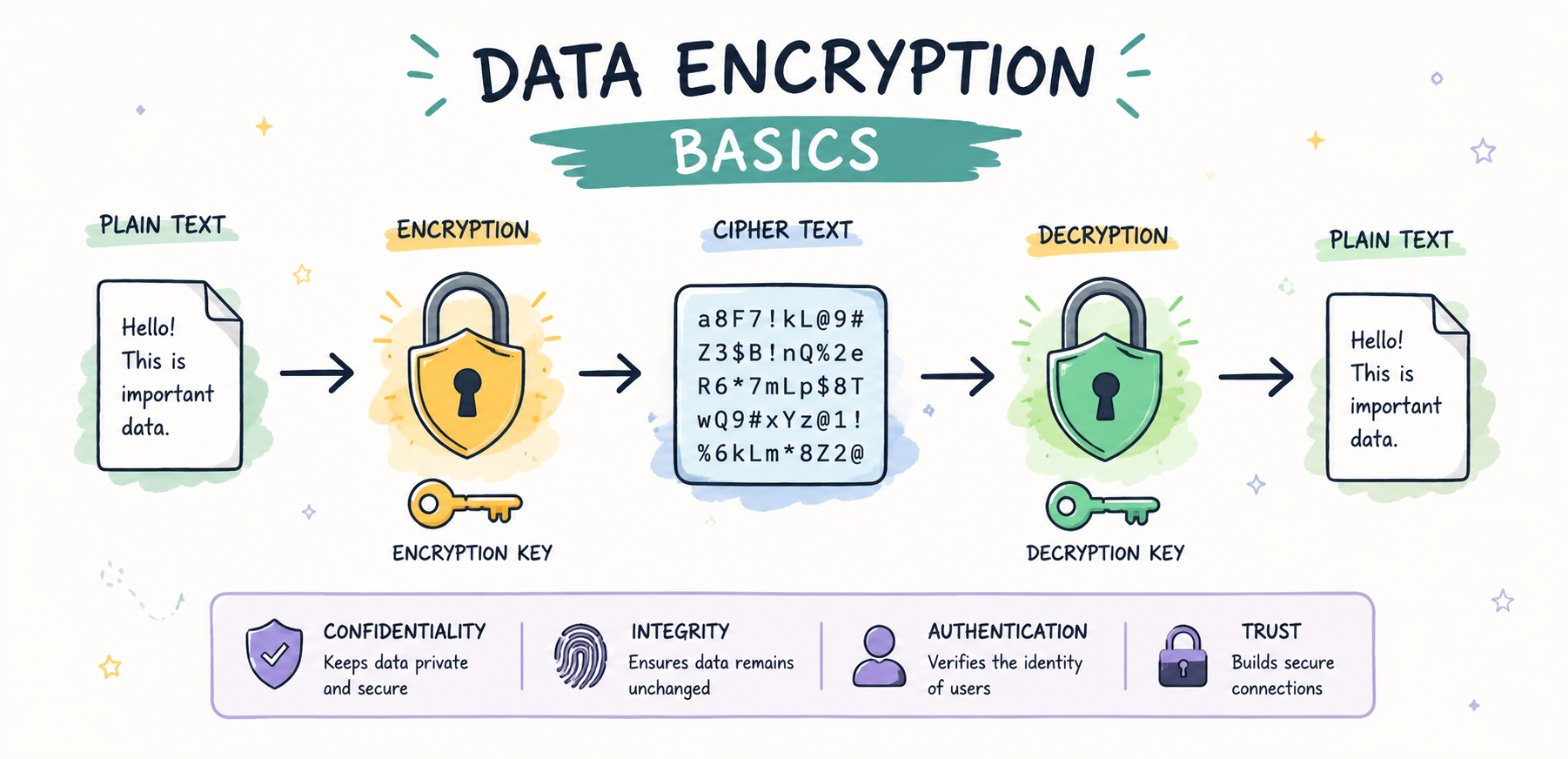
Data encryption is the process of converting readable information into an unreadable format called ciphertext. This encrypted data can only be accessed or decoded using a special key or password.
In simple words, encryption protects data by making it impossible for unauthorized users to understand the information.
For example, when you enter your password on a banking website, encryption ensures that hackers cannot easily steal or read your information during transmission.
Encryption is widely used in:
- Online banking
- Mobile applications
- Email services
- Cloud storage
- Social media platforms
- Government systems
- Healthcare databases
- eCommerce websites
- Corporate networks
Students joining Cyber Security Courses in Navi Mumbai often learn encryption as one of the foundational topics because it is a core part of modern cyber security systems.
Why Data Encryption is Important ?
With increasing cyber attacks and data leaks, encryption has become a necessity rather than an option.
Every organization today handles sensitive data such as:
- Customer information
- Employee records
- Payment details
- Confidential documents
- Intellectual property
- Login credentials
Without proper encryption, this data can be stolen, misused, or sold illegally.
Data encryption helps organizations:
- Protect sensitive information
- Prevent unauthorized access
- Secure online transactions
- Build customer trust
- Meet legal compliance requirements
- Reduce cyber security risks
For students learning cyber security, understanding encryption is extremely important because it forms the foundation of secure communication systems.
How Does Data Encryption Work ?
Encryption works using mathematical algorithms and encryption keys.
The process usually involves two main steps:
- Encryption
Readable data, also called plaintext, is converted into encrypted data or ciphertext using an encryption algorithm.
- Decryption
The encrypted data is converted back into readable format using a decryption key.
Only authorized users with the correct key can access the original information.
For example:
Original Message:
“Welcome to Cyber Security Training.”
Encrypted Message:
“Xj92@Lm#Qz7!kP”
Without the correct decryption key, the message becomes meaningless to hackers.
Types of Data Encryption
There are two major types of encryption methods used in cyber security.
Symmetric Encryption
Symmetric encryption uses the same key for both encryption and decryption.
This means the sender and receiver must have access to the same secret key.
Advantages of Symmetric Encryption
- Faster encryption process
- Suitable for large amounts of data
- Efficient performance
- Lower system resource usage
Disadvantages of Symmetric Encryption
- Key sharing can become risky
- Difficult to manage in large networks
- If the key is leaked, data becomes vulnerable
Popular symmetric encryption algorithms include:
- AES (Advanced Encryption Standard)
- DES (Data Encryption Standard)
- Triple DES
- Blowfish
AES is one of the most widely used encryption standards in modern cyber security.
Students pursuing Ethical Hacking and Cyber Security Courses often learn how AES encryption protects online communication and secure systems.
Asymmetric Encryption
Asymmetric encryption uses two different keys:
- Public key
- Private key
The public key encrypts data, while the private key decrypts it.
This method is also called Public Key Cryptography.
Advantages of Asymmetric Encryption
- Higher security
- Safer key distribution
- Better authentication
- Secure digital communication
Disadvantages of Asymmetric Encryption
- Slower compared to symmetric encryption
- More complex implementation
- Higher processing power required
Popular asymmetric encryption algorithms include:
- RSA
- ECC (Elliptic Curve Cryptography)
- Diffie-Hellman
Asymmetric encryption is commonly used in:
- Secure websites (HTTPS)
- Digital signatures
- Secure email communication
- Online banking systems
What is an Encryption Key ?
An encryption key is a special code used to encrypt and decrypt data.
The strength of encryption depends heavily on key size and complexity.
Common key sizes include:
- 128-bit
- 192-bit
- 256-bit
A larger key size provides stronger security because it becomes harder for hackers to crack the encryption.
For example, AES-256 encryption is considered highly secure and is widely used by governments, financial institutions, and technology companies.
Real-World Applications of Data Encryption
Data encryption is used almost everywhere in modern digital systems.
- Encryption in Online Banking
Banks use encryption to protect:
- Account details
- Transaction information
- Credit card data
- Login credentials
Whenever users access online banking portals, encrypted communication helps prevent cyber attacks.
- Encryption in Social Media Platforms
Platforms like messaging apps and social networks use encryption to secure private conversations and user data.
End-to-end encryption ensures that only the sender and receiver can read messages.
- Encryption in eCommerce Websites
Online shopping websites use SSL and TLS encryption protocols to secure customer payment information.
This helps protect users from payment fraud and identity theft.
- Encryption in Cloud Computing
Cloud service providers use encryption to protect stored files and transmitted data.
As cloud adoption increases, cloud security and encryption skills are becoming highly valuable for IT professionals.
- Encryption in Healthcare
Hospitals and healthcare organizations encrypt patient records to maintain privacy and comply with data protection regulations.
- Encryption in Cyber Security
Cyber security professionals use encryption to:
- Protect networks
- Secure devices
- Prevent unauthorized access
- Safeguard databases
- Monitor secure communication
This is why encryption is an essential module in advanced Cyber Security Training Programs.
What is SSL and TLS Encryption ?
SSL (Secure Sockets Layer) and TLS (Transport Layer Security) are encryption protocols used to secure internet communication.
When you visit a secure website, you may notice “HTTPS” in the browser URL.
The “S” in HTTPS stands for secure.
This security is achieved through SSL or TLS encryption.
These protocols help:
- Protect login credentials
- Secure online transactions
- Prevent data interception
- Build website trust
Students learning website security and cyber security fundamentals often study SSL certificates and HTTPS security implementation.
Importance of Encryption in Cyber Security Careers
Cyber security has become one of the fastest-growing industries globally.
Businesses across industries are investing heavily in cyber security technologies to protect their systems and customer data.
As a result, companies are actively hiring professionals with encryption and data security knowledge.
Popular career roles include:
- Cyber Security Analyst
- Ethical Hacker
- Information Security Specialist
- Security Engineer
- Network Security Administrator
- Cloud Security Expert
- Penetration Tester
- Digital Forensics Expert
Students searching for the Best Cyber Security Institute in Navi Mumbai often look for practical training programs that include encryption, ethical hacking, network security, and cloud security modules.
Role of AI in Data Encryption and Cyber Security
Artificial Intelligence is transforming the cyber security industry.
AI-powered systems can:
- Detect suspicious activities
- Identify cyber threats faster
- Predict hacking attempts
- Automate security monitoring
- Improve threat intelligence
AI is also being used to strengthen encryption systems and improve data protection.
Students enrolling in AI and Cyber Security Courses gain an advantage because businesses increasingly seek professionals with both AI and security skills.
The combination of AI, cyber security, and encryption knowledge creates strong career opportunities in the modern technology industry.
Common Encryption Challenges
Although encryption provides strong security, it also comes with certain challenges.
- Key Management Issues
Managing encryption keys securely can be difficult, especially for large organizations.
If encryption keys are lost, accessing encrypted data becomes impossible.
- Performance Impact
Encryption processes may slow down systems because they require additional computing power.
- Complex Implementation
Implementing advanced encryption systems requires technical expertise.
- Human Errors
Weak passwords, poor security practices, and incorrect configurations can reduce encryption effectiveness.
Cyber security training helps students understand how to avoid these mistakes.
Difference Between Encryption and Hashing
Many beginners confuse encryption with hashing.
Although both are used in cyber security, they work differently.
Encryption
- Data can be decrypted back into original form
- Uses encryption keys
- Protects sensitive communication
Hashing
- One-way process
- Data cannot be reversed easily
- Commonly used for password storage
Popular hashing algorithms include:
- SHA-256
- MD5
- SHA-1
Students learning Ethical Hacking and Cyber Security Fundamentals often study both encryption and hashing techniques.
Importance of Learning Data Encryption for Students
Learning data encryption offers several benefits for students pursuing technology careers.
- Strong Career Opportunities
Cyber security professionals are in high demand across industries.
- Practical Technical Skills
Encryption knowledge helps students understand real-world cyber security systems.
- Better Understanding of Digital Security
Students become more aware of online threats and data protection methods.
- Freelancing and Remote Work Opportunities
Cyber security professionals can work with companies globally.
- Higher Salary Potential
Experienced cyber security professionals often receive attractive salary packages.
Students searching for Cyber Security Courses in Navi Mumbai often prefer institutes that provide hands-on practical training, live projects, certification programs, and industry-focused learning.
Data Encryption Trends in 2026
The cyber security industry continues to evolve rapidly.
Some major encryption trends include:
- Quantum-Resistant Encryption
Researchers are developing encryption methods that can resist future quantum computer attacks.
- AI-Powered Security Systems
Artificial intelligence is improving threat detection and encryption monitoring.
- Zero Trust Security Models
Organizations are adopting stricter access control systems.
- Cloud Encryption Growth
Cloud security and encrypted cloud storage solutions are becoming more important.
- Multi-Factor Authentication
Businesses are combining encryption with additional security layers.
Students learning modern cyber security techniques should stay updated with these latest industry trends.
Importance of Cyber Security Education in Navi Mumbai
Navi Mumbai is rapidly becoming an important educational and technology hub.
Many students and working professionals are searching for:
- Best Cyber Security Courses in Navi Mumbai
- Ethical Hacking Training Institute
- AI and Cyber Security Programs
- Digital Marketing and Cyber Security Courses
- Network Security Certification
- Cloud Security Training
- Data Protection Courses
Educational institutes that provide practical cyber security training, live labs, industry certifications, and placement support are attracting more students.
Learning encryption basics is an important first step toward building a successful cyber security career.
How Digital Marketing and Cyber Security are Connected ?
Many businesses today combine digital marketing with strong cyber security practices.
For example:
- Websites collecting customer data must use encryption
- Online payment systems require secure communication
- Email marketing platforms protect user information
- Customer databases must remain secure
This is why many students are interested in learning both Digital Marketing and Cyber Security together.
Educational institutes offering integrated technology programs are becoming increasingly popular in Navi Mumbai.
Building a Career in Cyber Security
Students who want to build careers in cyber security should focus on:
- Networking fundamentals
- Encryption techniques
- Ethical hacking
- Cloud security
- Linux systems
- Programming basics
- Security testing
- AI-powered cyber security tools
Practical learning and real-world experience are extremely important in this field.
Institutes that provide hands-on cyber security training help students gain industry-ready skills.
Conclusion
Data encryption is one of the most important technologies in modern cyber security. From protecting personal messages and banking transactions to securing business databases and cloud systems, encryption plays a major role in keeping digital information safe.
As cyber threats continue to grow worldwide, the demand for skilled cyber security professionals is increasing rapidly. Students pursuing Cyber Security Courses in Navi Mumbai, Ethical Hacking Training, AI and Security Programs, or advanced technology certifications should understand encryption fundamentals because they form the foundation of secure digital communication.
Learning data encryption not only improves technical knowledge but also creates strong career opportunities in cyber security, cloud computing, ethical hacking, digital forensics, and IT security management.
With businesses investing heavily in cyber security and AI-powered protection systems, students with practical encryption knowledge will continue to remain highly valuable in the technology industry.
Whether you are a beginner exploring cyber security or a student planning a long-term IT career, understanding data encryption basics is an essential step toward becoming a skilled and future-ready cyber security professional.