


Firewalls Explained : A Simple and Practical Guide for Cyber Security Students in Navi Mumbai
Today, almost everything is connected to the internet.
From smartphones and laptops to online banking, cloud storage, educational portals, and business systems — digital technology has become a part of our daily lives. But as technology grows, cyber threats are growing too.
Hackers constantly try to steal data, spread malware, access private systems, and target businesses online. This is exactly why cyber security has become one of the most in-demand industries in the world.
Students searching for Cyber Security Courses in Navi Mumbai, Ethical Hacking Training, or Network Security Classes often come across one important topic repeatedly firewalls.
Firewalls are one of the most basic yet powerful security systems used to protect networks and devices from cyber attacks.
Whether you are a beginner exploring cyber security careers, a student learning networking basics, or someone pursuing AI and Digital Marketing Courses in Navi Mumbai, understanding firewalls is extremely important because modern businesses depend heavily on secure digital systems.
In this blog, we will understand what firewalls are, how they work, different types of firewalls, their advantages, limitations, and why learning firewall security can help students build strong careers in cyber security.
What is a Firewall?
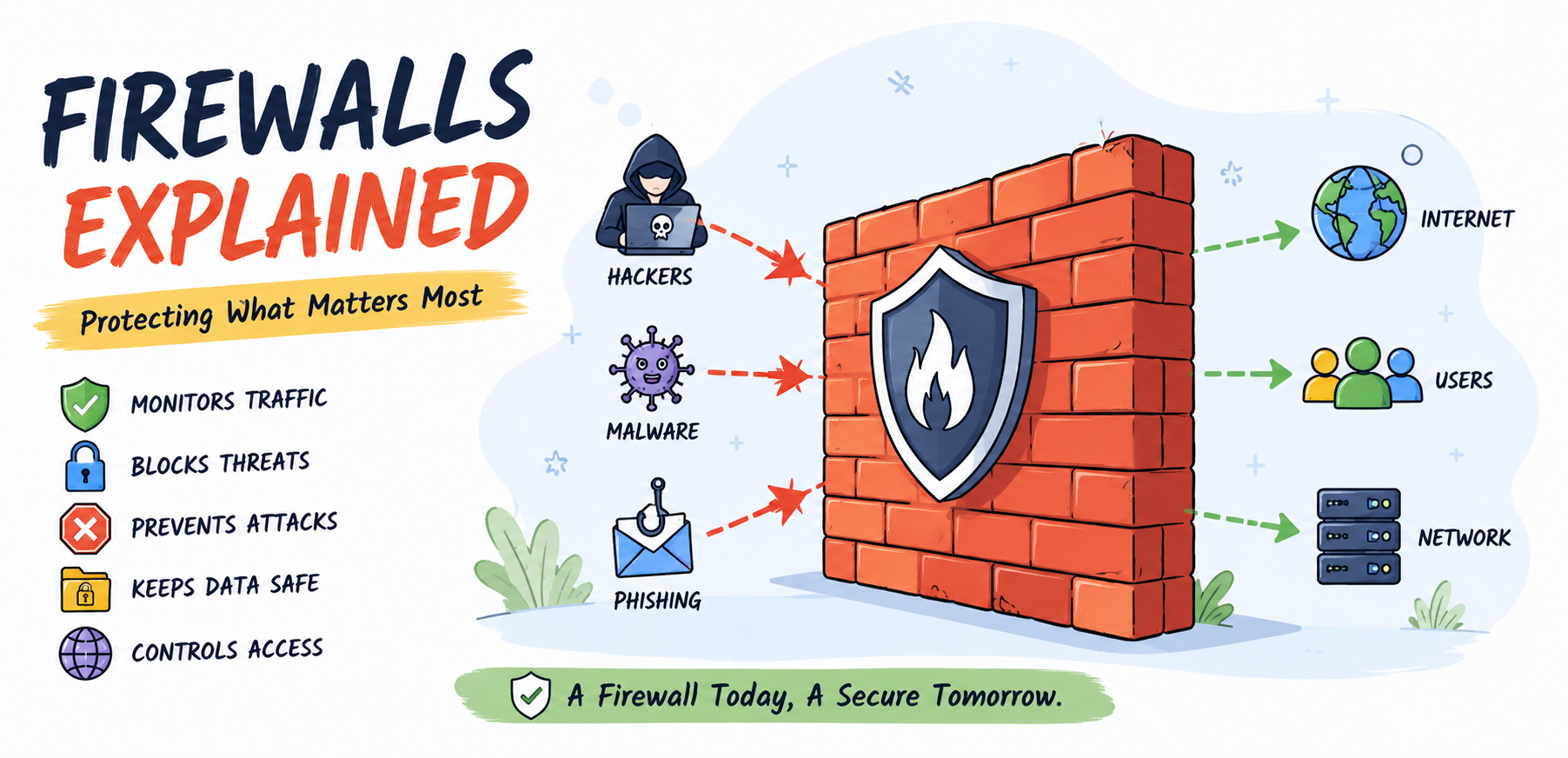
A firewall is a security system that monitors and controls incoming and outgoing network traffic.
In simple words, a firewall acts like a security checkpoint between your computer or network and the internet.
Its main job is to decide:
- Which traffic should be allowed
- Which traffic should be blocked
- Which users can access the system
- Which suspicious activities need to be stopped
Without a firewall, networks become much more vulnerable to:
- Hackers
- Malware
- Viruses
- Unauthorized access
- Cyber attacks
Think of a firewall like the security gate of a residential society.
Every person entering or leaving is checked.
Similarly, every piece of internet traffic passing through your network gets inspected by the firewall.
Why Firewalls are Important ?
Today, businesses store huge amounts of sensitive information online.
This includes:
- Customer details
- Payment information
- Employee records
- Business data
- Confidential files
Without proper security systems, this data can easily become a target for cyber criminals.
This is why firewalls are considered one of the most important components of cyber security.
Students enrolling in Cyber Security Training Institutes in Navi Mumbai must understand firewall concepts because they are widely used across almost every industry.
- Protects Against Unauthorized Access
- Firewalls prevent hackers from entering private networks.
- Blocks Harmful Traffic
- Modern firewalls can detect suspicious or dangerous activity.
- Improves Network Security
- Help businesses manage and secure internet traffic.
- Prevents Cyber Attacks
Firewalls help reduce risks from:
- Phishing attacks
- Malware
- Ransomware
- Spyware
- Data theft
- Botnet attacks
Builds Safer Online Systems
Organizations use firewalls to create secure digital environments for employees and customers.
How Does a Firewall Work?
Whenever data enters or leaves a network, the firewall checks it before allowing access.
The firewall analyzes:
- IP addresses
- Port numbers
- Protocols
- Traffic patterns
- Connection requests
Based on predefined security rules, it either:
- Allows the traffic
- Blocks the traffic
- Flags suspicious activity
For example:
If someone tries to access a company server using an unauthorized connection, the firewall can immediately block that attempt.
Modern firewalls have become much smarter.
Many advanced systems now use:
- Artificial Intelligence
- Machine Learning
- Behavioral analysis
- Threat intelligence
This is why students learning AI and Cyber Security together often gain a better understanding of modern digital protection systems.
Different Types of Firewalls
There are several types of firewalls used in cyber security.
Each type offers different levels of protection.
- Packet Filtering Firewall
Packet filtering firewalls are one of the oldest firewall technologies.
They inspect data packets based on:
- IP addresses
- Port numbers
- Protocol types
If the packet matches security rules, access is granted.
Otherwise, it gets blocked.
Advantages
- Fast performance
- Easy to manage
- Affordable
Limitations
- Basic security only
- Cannot deeply inspect traffic content
- Less effective against advanced cyber threats
- Stateful Inspection Firewall
Stateful inspection firewalls are more advanced.
Instead of checking packets individually, they monitor active connections and understand the context of network traffic.
This makes them more secure than traditional packet filtering firewalls.
Benefits
- Better traffic monitoring
- Improved protection
- Smarter filtering decisions
Many businesses and corporate networks use stateful inspection firewalls today.
- Proxy Firewall
A proxy firewall acts as a middle layer between users and the internet.
Instead of users directly accessing websites, the proxy firewall communicates on their behalf.
This adds another layer of security.
Advantages
- Hides internal IP addresses
- Improves privacy
- Filters dangerous traffic
Common Uses
- Educational institutes
- Corporate offices
- Government organizations
- Next-Generation Firewall (NGFW)
Cyber attacks are becoming more sophisticated every year.
To handle modern threats, companies now use Next-Generation Firewalls.
These firewalls combine traditional firewall protection with advanced security technologies.
Features of NGFW
- Deep packet inspection
- Malware detection
- Intrusion prevention
- Application monitoring
- AI-based threat detection
- Advanced traffic analysis
Students pursuing Advanced Cyber Security Courses in Navi Mumbai often learn about Next-Generation Firewalls because they are widely used in enterprise environments.
- Web Application Firewall (WAF)
A Web Application Firewall protects websites and web applications.
It filters HTTP and HTTPS traffic to block attacks targeting websites.
Protects Against
- SQL injection
- Cross-site scripting (XSS)
- Website hacking attempts
- Session hijacking
Web Application Firewalls are especially important for:
- E-commerce websites
- Banking applications
- Educational portals
- Online learning platforms
Hardware Firewall vs Software Firewall
Firewalls are mainly available in two forms.
Hardware Firewall
A hardware firewall is a physical security device installed between a network and the internet.
Benefits
- Protects multiple devices
- Strong network-level security
- Better performance for large systems
Commonly Used In
- Companies
- Data centers
- Colleges
- Large organizations
Software Firewall
A software firewall is installed directly on a computer or server.
Benefits
- Easy to install
- Budget-friendly
- Good for personal systems
Examples
- Windows Defender Firewall
- Antivirus firewall systems
- Endpoint protection software
Many businesses use both hardware and software firewalls together for stronger security.
Firewall Rules and Security Policies
A firewall works according to predefined rules.
These rules determine:
- Which traffic should be allowed
- Which websites can be accessed
- Which ports remain open
- Which IP addresses are trusted
Incorrect firewall settings can create major security risks.
That is why firewall configuration is an important skill taught in Cyber Security and Ethical Hacking Courses.
Importance of Firewalls for Businesses
Every business connected to the internet needs cyber security.
Whether it is a startup, hospital, educational institute, bank, or IT company, firewall protection is essential.
- Protects Customer Information
Businesses store sensitive customer data that must remain secure.
- Supports Remote Work
As remote work increases, businesses need secure internet connections.
- Reduces Financial Risks
Cyber attacks can cause huge financial losses.
Strong security systems reduce these risks.
- Helps Meet Security Compliance
Many industries require organizations to follow strict cyber security standards.
Firewalls help businesses maintain compliance.
Firewalls in Educational Institutes
Educational institutes are becoming increasingly digital.
Online classes, student portals, cloud systems, and digital learning platforms all require proper security.
Institutes offering Digital Marketing Courses, AI Training, and Cyber Security Programs in Navi Mumbai use firewalls to:
- Protect student data
- Secure online systems
- Block malicious websites
- Monitor internet usage
- Prevent hacking attempts
As cyber threats increase, educational organizations are investing more in cyber security infrastructure.
Common Challenges with Firewalls
Although firewalls are extremely useful, they are not perfect.
- Incorrect Configuration
Poor firewall setup can accidentally allow harmful traffic.
- Internal Threats
Firewalls mainly protect against external attacks.
They may not stop threats from inside the organization.
- Advanced Cyber Attacks
Some modern attacks can bypass traditional firewall systems.
That is why companies use multiple security layers.
- Performance Issues
Heavy traffic monitoring can sometimes slow down networks.
Best Practices for Firewall Security
Organizations should follow proper firewall management practices.
- Regular Updates
Firewall software should always stay updated.
- Monitor Firewall Logs
Security teams should regularly check firewall activity.
- Use Strong Security Rules
Only necessary traffic should be allowed.
- Combine Multiple Security Tools
Firewalls work best when combined with:
- Antivirus software
- Endpoint protection
- Intrusion detection systems
- Multi-factor authentication
- Conduct Security Audits
Regular security audits help identify weaknesses.
Career Opportunities in Firewall Security
Cyber security professionals with firewall skills are in high demand.
Students completing Cyber Security Courses in Navi Mumbai can explore careers such as:
- Network Security Engineer
- Cyber Security Analyst
- Ethical Hacker
- SOC Analyst
- Firewall Administrator
- Security Consultant
- Penetration Tester
The demand for cyber security professionals continues growing rapidly in India and globally.
Firewall Certifications Students Can Learn
Many students pursue certifications to improve their career opportunities.
Popular firewall and security certifications include:
- Certified Ethical Hacker (CEH)
- CompTIA Security+
- Cisco CCNA Security
- Palo Alto Firewall Certification
- Fortinet NSE Certification
- CISSP
Practical firewall skills can significantly improve employability in the cyber security industry.
How AI is Transforming Firewall Technology
Artificial Intelligence is changing cyber security rapidly.
Modern AI-powered firewalls can:
- Detect unusual behavior
- Predict threats
- Identify zero-day attacks
- Automate responses
- Reduce false alerts
Students learning both AI and Cyber Security gain future-ready technical skills.
Firewalls and Cloud Security
Today, many businesses use cloud platforms for storage and operations.
This has increased the importance of cloud firewall security.
Cloud firewalls help protect:
- Cloud applications
- Online databases
- Virtual servers
- Remote employees
Cloud security is now one of the fastest-growing fields in cyber security.
Firewall vs Antivirus Software
Many beginners think firewalls and antivirus software are the same.
However, both work differently.
Firewall
- Monitors network traffic
- Blocks unauthorized access
- Controls internet connections
Antivirus Software
- Detects malicious files
- Removes viruses
- Scans infected programs
Organizations usually use both together for complete protection.
Why Students Should Learn Firewall Security ?
Cyber security is one of the fastest-growing career industries today.
Companies need professionals who understand:
- Network security
- Firewall management
- Ethical hacking
- Threat analysis
- Cloud security
Students joining Cyber Security Institutes in Navi Mumbai gain practical knowledge that helps them build successful careers in IT and security.
Firewall knowledge is useful not only for cyber security professionals but also for:
- Digital marketers managing websites
- AI developers working on cloud systems
- IT administrators
- Software engineers
Future of Firewall Technology
Firewall technology continues evolving with modern cyber threats.
Future firewalls will increasingly use:
- Artificial Intelligence
- Machine Learning
- Automation
- Cloud integration
- Behavioral analytics
- Real-time threat detection
Cyber security professionals must continuously update their skills to stay ahead of new threats.
Conclusion
Firewalls are one of the most important parts of modern cyber security.
They help protect networks, devices, websites, applications, and sensitive information from cyber attacks and unauthorized access.
From basic packet filtering systems to advanced AI-powered Next-Generation Firewalls, firewall technology continues evolving to meet modern security challenges.
For students pursuing Cyber Security Courses, Ethical Hacking Training, AI Programs, or Digital Marketing Courses in Navi Mumbai, understanding firewall security is extremely valuable.
As businesses become more dependent on digital systems, the demand for skilled cyber security professionals continues growing rapidly.
Learning how firewalls work can help students build strong foundations in network security and open doors to exciting career opportunities.
Whether you want to become a Security Analyst, Ethical Hacker, Network Engineer, or Cyber Security Consultant, firewall knowledge is one of the essential skills every modern IT professional should understand.