

AI in Healthcare: How Artificial Intelligence is Changing the Future of Medicine
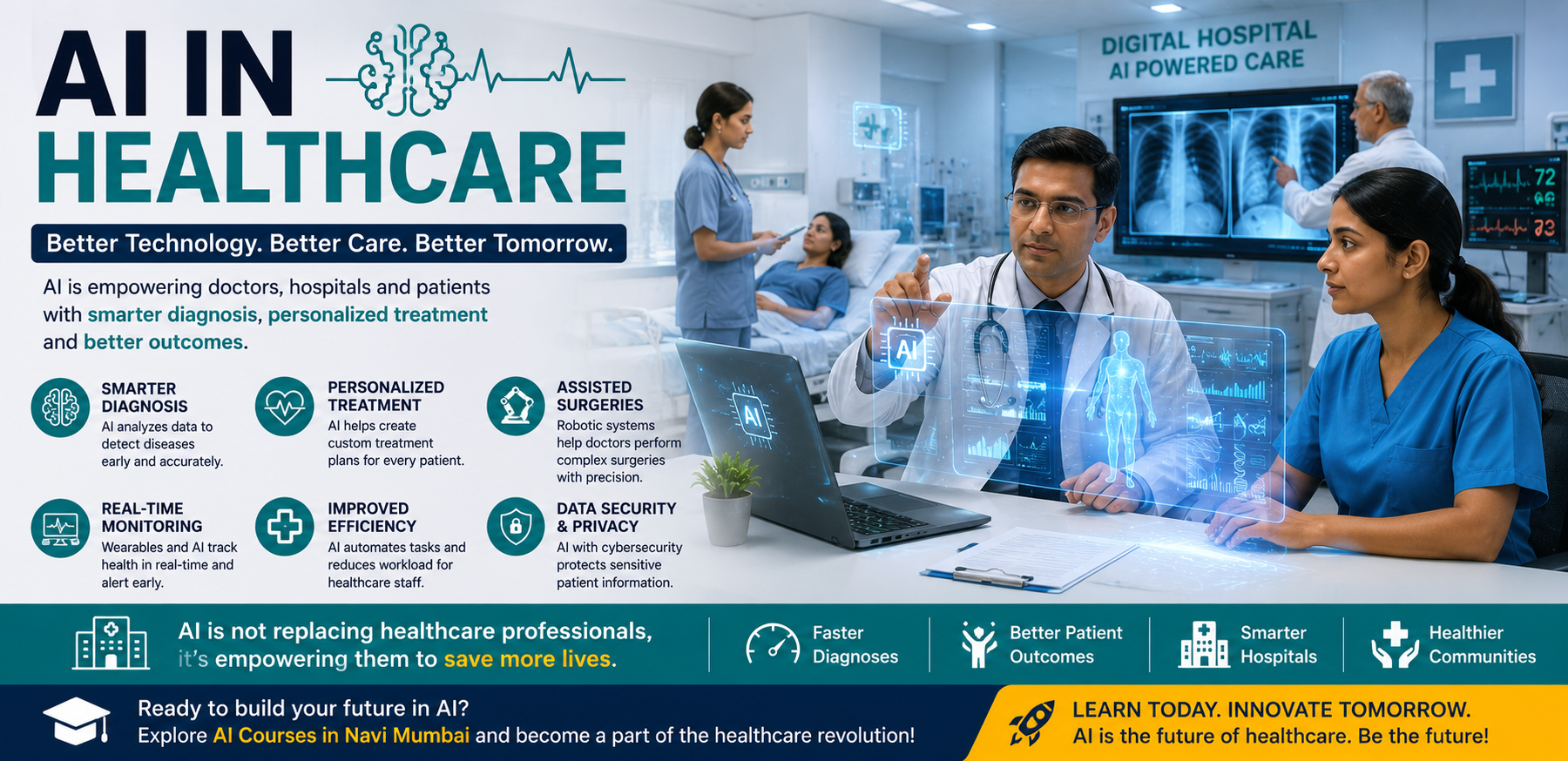
Technology is changing the world around us faster than ever before, and one of the industries experiencing a major transformation is Healthcare. Hospitals, clinics, research centers, and healthcare companies are now using Artificial Intelligence (AI) to improve patient care, detect diseases faster, and make medical services smarter and more efficient.
A few years ago, the idea of machines helping doctors diagnose diseases or robots assisting in surgeries sounded futuristic. Today, it is becoming a reality. AI is already helping healthcare professionals analyze medical data, identify health risks, improve treatments, and even support patients through virtual assistants and smart health devices.
For students interested in technology, innovation, or future-focused careers, AI in healthcare has become one of the most exciting and rapidly growing fields. Many students searching for AI Courses in Navi Mumbai are now exploring healthcare applications because this industry offers excellent career opportunities and long-term growth.
In this blog, we’ll understand AI in healthcare in a simple and practical way how it works, where it is being used, its benefits, challenges, career opportunities, and why learning AI can help students build a strong future in the digital world.
What is AI in Healthcare?
Artificial Intelligence in healthcare refers to the use of smart computer systems and technologies that can perform tasks which normally require human intelligence.
These AI systems can:
- Analyze medical data
- Detect patterns
- Make predictions
- Assist doctors in decision-making
- Automate repetitive healthcare tasks
AI technologies are used in:
- Hospitals
- Diagnostic labs
- Medical research centers
- Healthcare apps
- Wearable devices
- Telemedicine platforms
Some common AI technologies used in healthcare include:
- Machine Learning
- Deep Learning
- Natural Language Processing (NLP)
- Computer Vision
- Predictive Analytics
Today, AI is helping healthcare professionals work faster, more accurately, and more efficiently.
Why is AI Becoming So Important in Healthcare?
The healthcare industry generates huge amounts of data every single day.
This includes:
- Medical reports
- Patient records
- X-rays and scans
- Blood test results
- Prescriptions
- Research data
Managing all this information manually is difficult and time-consuming.
This is where AI becomes useful.
AI can quickly analyze large amounts of data and identify patterns that humans may miss. It helps doctors make better decisions and improves the overall quality of healthcare services.
Healthcare organizations around the world are investing heavily in AI because it helps:
- Save time
- Improve diagnosis accuracy
- Reduce human errors
- Improve patient care
- Automate repetitive tasks
This growing demand is one reason why students are increasingly joining Artificial Intelligence Courses in Navi Mumbai to build future-ready technical skills.
How Does AI Work in Healthcare?
AI systems work by learning from large amounts of healthcare data.
Here’s a simple understanding of the process:
- Data Collection
AI systems collect healthcare data from:
- Electronic Health Records (EHRs)
- Medical imaging scans
- Smart health devices
- Lab reports
- Patient histories
- Data Analysis
Machine learning algorithms study this data and identify patterns or abnormalities.
- Predictions and Recommendations
Based on analysis, AI systems provide:
- Disease predictions
- Treatment suggestions
- Health risk alerts
- Continuous Learning
AI systems improve over time as they process more data.
This ability to continuously learn and improve makes AI extremely valuable in healthcare environments.
Applications of AI in Healthcare
AI is already being used in many areas of healthcare today.
Disease Detection and Diagnosis
One of the biggest uses of AI is disease diagnosis.
AI systems can analyze:
- X-rays
- MRI scans
- CT scans
- Blood reports
to identify diseases more quickly and accurately.
AI helps doctors detect:
- Cancer
- Heart disease
- Diabetes
- Brain disorders
- Lung infections
In some cases, AI systems can detect diseases at earlier stages, increasing the chances of successful treatment.
Medical Imaging
Medical imaging is another area where AI is making a huge impact.
AI-powered tools help doctors analyze:
- X-rays
- Mammograms
- Ultrasounds
- Radiology scans
These systems can detect abnormalities that may be difficult to notice manually.
This improves both speed and accuracy in diagnosis.
Personalized Treatment Plans
Every patient is different, and treatments may not work the same way for everyone.
AI helps create personalized treatment plans based on:
- Medical history
- Lifestyle
- Genetic information
- Previous treatments
This helps doctors provide more effective and customized healthcare solutions.
Virtual Health Assistants
Many healthcare organizations now use AI-powered chatbots and virtual assistants.
These systems help patients:
- Book appointments
- Get medicine reminders
- Track symptoms
- Receive basic health guidance
Virtual assistants improve patient communication and reduce hospital workload.
Drug Discovery and Research
Developing new medicines is expensive and time-consuming.
AI helps researchers:
- Analyze chemical compounds
- Predict drug effectiveness
- Speed up clinical research
This helps pharmaceutical companies develop medicines faster.
Robotic Surgery
AI-powered robots are assisting doctors in performing complex surgeries with high precision.
Benefits of robotic-assisted surgery include:
- Smaller cuts
- Faster recovery
- Reduced pain
- Better accuracy
While robots don’t replace doctors, they support surgeons in improving surgical precision.
Predictive Healthcare
AI systems can predict health risks before they become serious.
For example, AI can help identify patients who are at risk of:
- Heart attacks
- Diabetes complications
- Hospital readmissions
This allows doctors to take preventive action earlier.
Smart Wearable Devices
Smart health devices like fitness bands and smartwatches also use AI.
These devices monitor:
- Heart rate
- Sleep patterns
- Oxygen levels
- Physical activity
AI analyzes this data and provides health insights in real time.
Benefits of AI in Healthcare
AI offers many advantages to both healthcare professionals and patients.
- Faster Diagnosis
AI can process medical data much faster than humans.
- Improved Accuracy
AI reduces human errors and improves diagnostic accuracy.
- Better Patient Care
Personalized healthcare improves treatment outcomes and patient satisfaction.
- Reduced Workload
Automation helps healthcare staff focus on more important tasks.
- Early Disease Detection
AI can identify diseases at early stages, improving recovery chances.
- Better Data Management
AI systems help organize and analyze large healthcare datasets efficiently.
These benefits explain why AI adoption in healthcare is increasing rapidly worldwide.
Real-World Examples of AI in Healthcare
AI is no longer just experimental technology. It is already being used in real healthcare environments.
- AI in Cancer Detection
AI systems are helping doctors detect cancer through imaging analysis.
- AI During COVID-19
AI was used during the pandemic to track infection patterns and analyze symptoms.
- Smart Health Monitoring
Wearable devices continuously track user health and alert users about abnormal activity.
- AI Chatbots
Hospitals use chatbots to improve patient communication and appointment scheduling.
- Robotic Surgeries
Advanced hospitals now use robotic systems for precision surgeries.
These innovations show how AI is transforming modern healthcare systems.
The Role of Machine Learning in Healthcare
Machine Learning is one of the most important parts of AI.
Machine learning systems learn from data and improve automatically over time.
In healthcare, machine learning helps:
- Predict diseases
- Analyze medical images
- Identify health trends
- Improve diagnosis systems
Students pursuing Machine Learning Courses in Navi Mumbai are increasingly exploring healthcare applications because of growing industry demand.
Cyber Security Challenges in AI Healthcare
As healthcare systems become more digital, cyber security becomes extremely important.
Healthcare organizations store sensitive patient information, making them targets for cyber attacks.
Possible risks include:
- Data breaches
- Ransomware attacks
- Medical identity theft
- Unauthorized system access
Strong cyber security systems are essential to protect patient data and healthcare networks.
This is why many students today are combining AI and Cyber Security Courses in Navi Mumbai to build advanced technical skills.
Ethical Concerns of AI in Healthcare
Although AI offers many benefits, there are also important ethical concerns.
- Data Privacy
Patient data must remain secure and confidential.
- Bias in AI Systems
If AI systems are trained using limited or biased data, results may become unfair or inaccurate.
- Overdependence on Technology
Doctors should use AI as a support tool, not as a complete replacement for human judgment.
- Job Replacement Concerns
Some people worry that automation may reduce certain healthcare jobs.
Responsible and ethical use of AI is important for the future of healthcare.
Career Opportunities in AI Healthcare
AI in healthcare is creating exciting career opportunities for students.
Popular job roles include:
- AI Engineer
Builds AI systems and healthcare algorithms.
- Healthcare Data Analyst
Analyzes medical data and generates insights.
- Machine Learning Engineer
Develops predictive healthcare models.
- Healthcare Technology Consultant
Helps organizations implement AI solutions.
- Cyber Security Specialist
Protects healthcare systems and patient data.
- Bioinformatics Specialist
Uses AI and data science in biological and medical research.
Students with AI and cyber security skills are likely to see strong career opportunities in the coming years.
Skills Needed for AI Healthcare Careers
Students interested in AI healthcare should focus on learning:
- Artificial Intelligence
- Machine Learning
- Python Programming
- Data Science
- Cyber Security
- Cloud Computing
- Data Analytics
The best AI Training Institutes in Navi Mumbai provide practical learning, projects, and hands-on experience to help students prepare for industry careers.
Why Students Should Learn AI Today
AI is becoming one of the most valuable skills in the modern world.
Here’s why students should consider learning AI:
- High Industry Demand
AI professionals are needed across multiple industries.
- Excellent Salary Opportunities
AI-related careers offer strong earning potential.
- Future-Proof Technology
AI will continue growing in the coming years.
- Global Career Scope
AI skills are valuable worldwide.
- Innovation Opportunities
Students can work on advanced technologies and real-world solutions.
Students who combine AI with digital marketing and cyber security knowledge can build highly versatile careers.
AI and Digital Marketing in Healthcare
Healthcare organizations also use AI in Digital Marketing.
AI helps healthcare brands:
- Personalize advertisements
- Improve customer engagement
- Automate communication
- Analyze patient behavior
- Optimize marketing campaigns
This is why many Digital Marketing Courses in Navi Mumbai now include AI-powered marketing tools and automation concepts.
The Future of AI in Healthcare
The future of AI in healthcare looks extremely exciting.
Future advancements may include:
- Fully AI-powered hospitals
- Advanced robotic surgeries
- Smart healthcare assistants
- Predictive healthcare systems
- AI-powered mental health support
- Personalized medicine using genetic data
As technology continues evolving, AI will play an even bigger role in improving healthcare services around the world.
Conclusion
Artificial Intelligence is transforming healthcare in ways that were once impossible to imagine. From faster disease detection and personalized treatments to robotic surgeries and predictive healthcare systems, AI is helping improve medical services for both doctors and patients.
As healthcare becomes more digital, the demand for skilled AI professionals will continue to grow rapidly.
For students interested in technology, healthcare innovation, data science, or cyber security, AI in healthcare offers exciting career opportunities and long-term growth potential.
If you want to build future-ready technical skills, joining an AI Course in Navi Mumbai can help you gain practical knowledge, hands-on experience, and industry exposure in Artificial Intelligence, Machine Learning, Cyber Security, and Emerging Technologies.
With the right skills and continuous learning, students can become part of the next generation of innovation that is shaping the future of healthcare and technology.