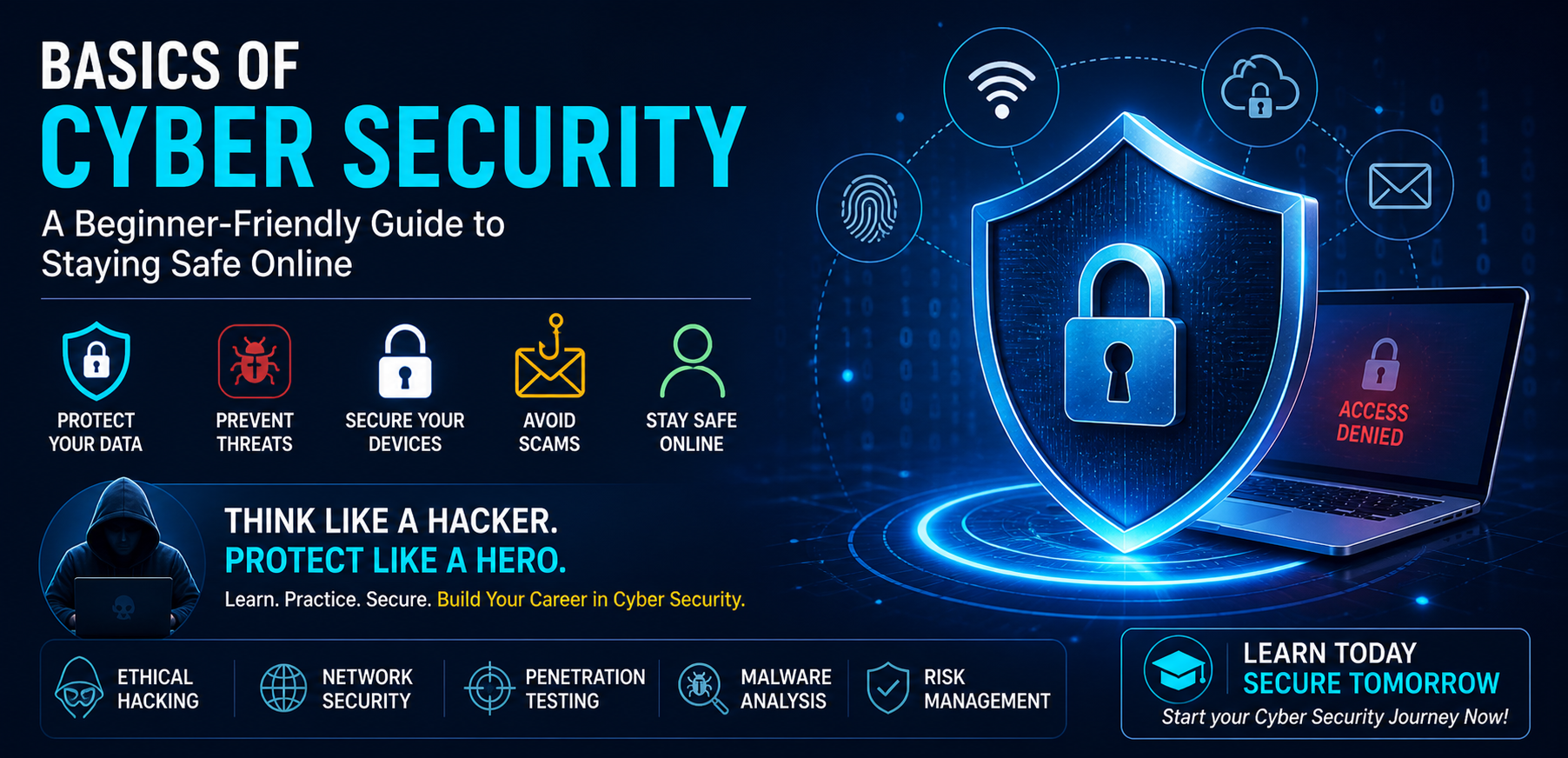



Today, almost every business uses computers, websites, mobile applications, cloud platforms, and online payment systems. While technology makes our lives easier, it also creates security risks. Companies need trained professionals who can protect their systems, identify weaknesses, and prevent cyberattacks.
This is where cyber security professionals play an important role.
HackTechMedia, located in CBD Belapur, Navi Mumbai, offers cyber security training designed to help students understand cybersecurity concepts and develop practical technical skills. The institute focuses on practical learning, virtual labs, and real-world project exposure to help learners prepare for the challenges of the cybersecurity industry.
Whether you are a college student, a fresher, an IT professional, or someone planning to change careers, this guide will help you understand why cyber security is a career worth exploring and what you should look for when choosing a cyber security course in Navi Mumbai.
1. Why Is Cyber Security a Good Career Choice?
Think about how much personal and business information is stored online today.
Banks manage financial information digitally. Hospitals store patient records. Companies maintain customer databases. Online businesses process payments, and people use mobile applications for everyday activities.
All these systems need protection.
Cybersecurity is the practice of protecting computers, networks, applications, and data from unauthorised access, misuse, damage, and cyberattacks.
Some common cybersecurity threats include:
- Phishing emails and fraudulent websites
- Password theft and account hacking
- Ransomware and malicious software
- Data breaches and information leaks
- Website vulnerabilities
- Network attacks
- Cloud security risks
As organisations adopt cloud services, artificial intelligence, and connected digital systems, security requirements continue to evolve.
According to the Data Security Council of India and SANS Institute's Indian Cyber Security Skilling Landscape 2025–2026 report, 73% of surveyed enterprises reported limited availability of skilled cybersecurity candidates. The report also highlighted gaps in the practical skills of job applicants.
This shows why students should focus on developing genuine technical skills rather than collecting certificates alone.
Cybersecurity can offer career opportunities across IT services, banking, healthcare, consulting, e-commerce, telecommunications, and other industries. However, success depends on your knowledge, practical ability, experience, and the specific skills employers need.
2. Why Choose HackTechMedia for Cyber Security Training in Navi Mumbai?
When you search for the best cyber security institute in Navi Mumbai, you should look beyond advertisements and course fees. A good institute should help you understand technical concepts and practise what you learn.
HackTechMedia aims to combine cybersecurity education with practical exposure so students can build a stronger foundation for their careers.
Here are some factors to consider when exploring its training programmes.
Practical Cyber Security Training
Reading about hacking and security is not the same as understanding how security tools work.
For example, a student may understand what a network port is but still struggle to identify open ports during a security assessment.
Practical exercises help students connect theoretical knowledge with real technical tasks.
At HackTechMedia, learners can explore cybersecurity concepts through practical sessions and virtual lab environments. The exact tools and exercises covered will depend on the selected course.
Learn from the Basics
You do not always need to be an experienced cybersecurity professional before starting a course.
Beginners can start by learning computer fundamentals, networking, operating systems, and basic security concepts. They can gradually progress to more advanced topics.
A structured learning path is especially useful for students who are interested in ethical hacking but do not yet understand how networks and operating systems work.
Training in CBD Belapur
HackTechMedia is located at Prabhat Centre, Sector 1A, CBD Belapur, Navi Mumbai.
Its location makes it worth considering for students searching for:
- Cyber security institute near Vashi
- Ethical hacking course in Navi Mumbai
- Cyber security course in CBD Belapur
- Cyber security training near Nerul
- Cyber security classes near Kharghar
- Cyber security institute near Panvel
If you live in Navi Mumbai or nearby areas, you can explore the course options and discuss the training format before enrolling.
Multiple Cyber Security Learning Paths
Cybersecurity is a broad field. Not every student wants to become an ethical hacker, and not every cybersecurity job involves penetration testing.
HackTechMedia lists different levels of cybersecurity training, including certificate, advanced, and diploma-level programmes.
You can explore the available options on the official website:
https://hacktechmedia.com/courses/
Compare the syllabus, practical exercises, course duration, certification details, and fees before choosing a programme.
3. What Will You Learn in a Cyber Security Course?
A good cybersecurity learning programme should help you build your skills step by step.
The following topics are important to understand when comparing cybersecurity courses.
Computer Networking
Networking is one of the foundations of cybersecurity.
You should understand IP addresses, DNS, ports, protocols, routers, switches, and how computers communicate with each other.
Without networking knowledge, it can be difficult to understand how attackers target systems or how security professionals monitor network activity.
Linux and Windows Operating Systems
Cybersecurity professionals regularly work with different operating systems.
Linux knowledge is useful for security testing, system administration, and working with many cybersecurity tools. Windows knowledge is important for understanding user accounts, permissions, system configurations, and enterprise environments.
Learning both can give students a stronger technical foundation.
Ethical Hacking
Ethical hacking involves testing computer systems and applications for security weaknesses with proper authorisation.
Students may learn how security assessments are planned, how vulnerabilities are identified, and how findings are documented.
All practical testing should take place in authorised environments, training laboratories, or systems for which permission has been granted.
Ethical hacking is not about breaking into somebody else's computer. It is about helping organisations discover and fix security problems responsibly.
Vulnerability Assessment and Penetration Testing
Vulnerability Assessment and Penetration Testing, commonly called VAPT, is used to identify and evaluate security weaknesses.
A vulnerability assessment helps identify possible problems. Penetration testing goes further by testing selected weaknesses within an agreed scope to understand their potential impact.
Students interested in this field should learn how to document findings, explain risks, and recommend corrective actions.
Network Security and Firewalls
Network security focuses on protecting communication between devices and systems.
Important concepts include firewall rules, access control, network segmentation, secure configurations, and traffic monitoring.
These skills are useful for students who want to explore network security or infrastructure security roles.
Security Operations Centre (SOC)
A Security Operations Centre monitors systems and investigates possible security incidents.
SOC analysts may review alerts, examine logs, investigate suspicious activities, and help security teams respond to threats.
Students interested in SOC roles should pay attention to log analysis, incident response, security monitoring, and Security Information and Event Management (SIEM) tools.
Cyber Forensics
Cyber forensics involves examining digital evidence in a structured and legally appropriate manner.
It can include analysing files, system logs, storage devices, and other digital information to understand what happened during a security incident.
This area may interest learners who enjoy investigation, problem-solving, and detailed technical analysis.
4. Career Opportunities After Cyber Security Training
One of the biggest questions students ask is, "What job can I get after completing a cyber security course?"
The answer depends on your technical foundation, the course you complete, your practical experience, and the requirements of employers.
Here are some career paths worth exploring.
1. SOC Analyst
SOC analysts monitor security alerts, investigate suspicious activities, and help organisations identify possible cyber threats.
2. Junior Security Analyst
Junior security analysts support security assessments, review system information, and assist with security monitoring and incident investigations.
3. Network Security Engineer
Network security professionals help configure, maintain, and protect network infrastructure.
4. Penetration Tester
Penetration testers conduct authorised security tests to identify vulnerabilities and assess how systems could be compromised.
5. Vulnerability Assessment Analyst
These professionals identify security weaknesses, assess their severity, and help organisations prioritise fixes.
6. Cyber Forensics Analyst
Digital forensics professionals examine digital evidence and support investigations involving computers, storage devices, and other digital systems.
7. Information Security Consultant
With suitable experience, professionals may advise organisations on security controls, risk management, policies, and compliance.
Remember that completing a course does not automatically qualify you for every role. Some positions require additional experience, specialised knowledge, or professional certifications.
A sensible approach is to choose an entry-level role, identify its required skills, and build your learning plan around those requirements.
5. Is Cyber Security Suitable for Freshers?
Yes. Cybersecurity can be a suitable career path for freshers, provided they are willing to learn technical concepts and practise consistently.
You do not have to know everything on your first day.
Start with computer fundamentals and networking. Learn Linux and Windows basics. Understand common cyber threats and security principles. Then move towards a specialisation such as SOC operations, ethical hacking, network security, or digital forensics.
Students from computer science, IT, and engineering backgrounds may already have some relevant knowledge. Students from other backgrounds can also explore cybersecurity, although they may need additional time to build their technical foundation.
The most important qualities are curiosity, patience, logical thinking, problem-solving ability, and a willingness to keep learning.
Cybersecurity tools and threats change frequently, so learning does not stop when a course ends.
6. Why Practical Knowledge Matters More Than Certificates Alone
Imagine two candidates applying for the same entry-level cybersecurity job.
The first candidate has completed several certificates but cannot explain how to investigate a suspicious network connection.
The second candidate has fewer certificates but understands networking, can examine logs in a lab, recognises common security issues, and can explain how to document a finding.
The second candidate may be better prepared for practical work.
This is why students should evaluate a training institute based on more than the certificate it provides.
Before enrolling at HackTechMedia or any other institute, ask questions such as:
- Will I get regular hands-on practice?
- Are virtual labs included?
- Will I complete practical assignments or projects?
- Will I learn how to document security findings?
- Can the trainer explain real-world use cases?
- Is there support for doubts and revision?
- What exactly does the course certificate represent?
- Is interview preparation or placement assistance included?
These questions will help you understand whether the programme matches your career goals.
7. How to Choose the Right Cyber Security Course
Not every cybersecurity course is suitable for every learner.
Before paying your course fees, take the time to compare programmes.
If you are a beginner: Look for networking, operating systems, security fundamentals, and guided lab practice.
If you already work in IT: Consider programmes that build on your existing knowledge and focus on security operations, network defence, cloud security, or VAPT.
If you want to become an ethical hacker: Check whether the syllabus includes authorised testing methodologies, web application security, vulnerability analysis, reporting, and remediation.
If you want to work in a SOC: Look for security monitoring, log analysis, SIEM concepts, incident investigation, and alert handling.
If you are interested in cyber forensics: Look for digital evidence handling, forensic methods, file-system analysis, and investigation procedures.
Also compare course duration, total fees, practical hours, trainer experience, batch size, and post-course support.
A good course should provide a clear learning path instead of promising that you will become an expert in just a few days.
8. Cyber Security Training for Working Professionals
Cybersecurity is not limited to college students and freshers.
IT support executives, network administrators, system administrators, software developers, and other technology professionals may benefit from learning security skills.
For example, a network administrator who understands firewall management and security monitoring may be able to prepare for a move into network security.
A developer who learns secure coding and application security may explore application security roles.
An IT support professional who improves their networking and operating system knowledge may begin preparing for junior security operations positions.
The best learning path depends on your existing experience and the role you want to pursue.
If you are already working, discuss your career goals with the institute and ask which programme matches your current skill level.
9. The Future of Cyber Security in India
Cybersecurity is changing as organisations adopt cloud computing, artificial intelligence, automation, and connected technologies.
The India Cyber Security Skilling Landscape 2025–2026 report from DSCI and SANS highlights the importance of practical skills and the growing need for specialised capabilities.
AI security, cloud security, application security, threat detection, and security architecture are among the areas attracting attention.
This does not mean every student should immediately specialise in artificial intelligence or advanced cloud security.
A strong foundation is still essential. Students should first understand networking, operating systems, security fundamentals, and basic troubleshooting before moving towards advanced topics.
As you gain experience, you can explore a specialisation that matches your interests and market requirements.
For students in Navi Mumbai, this is an opportunity to start building relevant skills while studying or working. However, job availability, salaries, and hiring requirements vary by employer and experience level.
No institute can honestly guarantee that every student will achieve the same career outcome without considering these factors.
10. Why Consider HackTechMedia in CBD Belapur, Navi Mumbai?
Choosing a cyber security institute is an important decision because the right learning environment can make difficult technical subjects easier to understand.
HackTechMedia positions itself as a cybersecurity and digital marketing training organisation with practical learning and virtual lab resources.
Students exploring HackTechMedia can review its courses, discuss their goals with the training team, and check whether the programme includes the technical practice they need.
Before joining, make sure you understand the course syllabus, duration, fees, certification arrangements, and any placement or job-assistance terms in writing.
The goal should be to develop skills that you can demonstrate, explain, and continue improving throughout your career.
If you are searching online for a cyber security institute in Navi Mumbai, an ethical hacking course near Vashi, or cyber security classes in CBD Belapur, HackTechMedia is an option worth exploring.
Visit the official website to learn more:
11. Frequently Asked Questions
Which is the best cyber security institute in Navi Mumbai?
The best institute for you is one that offers a suitable syllabus, practical lab sessions, experienced trainers, transparent fees, and clear certification details. HackTechMedia in CBD Belapur is one option to explore when comparing cybersecurity training institutes in Navi Mumbai.
Can I learn ethical hacking without coding knowledge?
Yes, beginners can start learning ethical hacking without advanced coding knowledge. However, networking, operating systems, scripting, and programming basics become increasingly useful as you progress.
How long does it take to learn cyber security?
The duration depends on your starting level and the course you choose. A foundation course may take less time than an advanced programme covering penetration testing or security operations. Becoming job-ready also requires regular practice beyond classroom sessions.
What is the difference between cyber security and ethical hacking?
Cybersecurity is the broader field of protecting systems, networks, applications, and data. Ethical hacking is one part of cybersecurity that involves authorised testing to identify security weaknesses.
Is a cyber security certificate enough to get a job?
A certificate can demonstrate that you have completed a course, but employers may also assess technical knowledge, practical ability, projects, communication, and experience. Build a portfolio of legal lab exercises and documented projects to demonstrate your skills.
Where is HackTechMedia located?
HackTechMedia is located at Prabhat Centre, Sector 1A, CBD Belapur, Navi Mumbai, Maharashtra 400614. Contact the institute to confirm the latest batch schedule and course details.
Start Building Your Cyber Security Career with HackTechMedia
Cybersecurity is an exciting field for people who enjoy technology, investigation, and solving problems. However, building a successful career requires more than choosing a popular course. You need a strong foundation, practical experience, patience, and a willingness to keep learning.
If you are looking for the best cyber security institute in Navi Mumbai, take the time to understand your career goals and compare the available training options.
HackTechMedia in CBD Belapur offers cybersecurity learning programmes that you can explore as part of your career planning.
Start by understanding the basics, practise in authorised labs, work on projects, and prepare for the requirements of your chosen role.
Your cybersecurity career starts with the skills you build today.
Contact HackTechMedia
Institute: HackTechMedia
Location: Prabhat Centre, Sector 1A, CBD Belapur, Navi Mumbai, Maharashtra 400614
Phone: +91 75065 90900
Website: https://hacktechmedia.com/
Explore courses: https://hacktechmedia.com/courses/
Contact HackTechMedia to discuss your learning goals and find a cybersecurity programme that suits your current knowledge and career plans.