


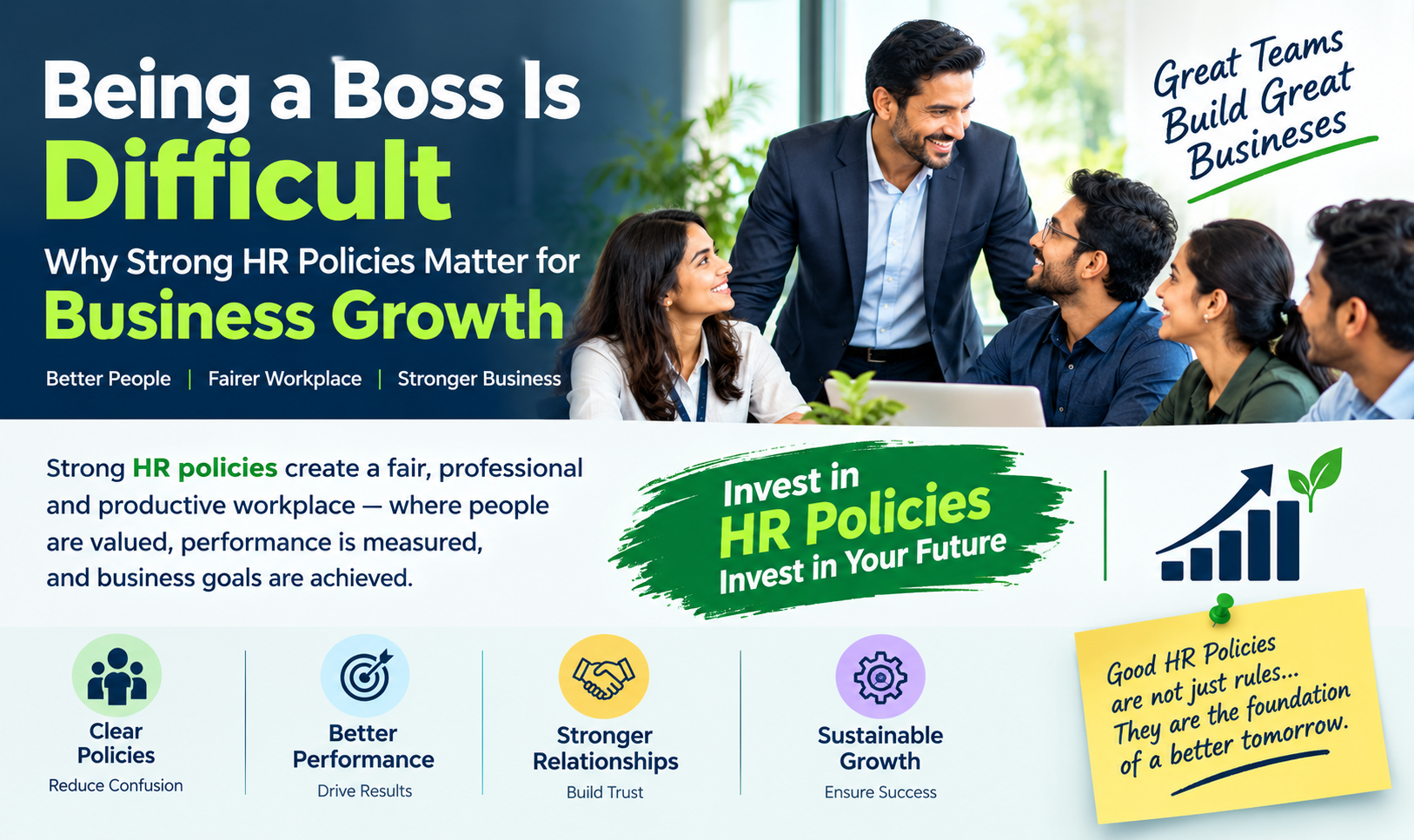
Being a business owner is not as easy as it may appear. People often see the position of a boss as one of power, authority, and freedom. However, behind every successful business, there is a leader who faces difficult decisions, manages people, handles financial pressure, and takes responsibility for the company's future.
One of the most challenging aspects of leadership is managing relationships with employees.
When a boss starts caring deeply about employees, spending personal time with them, and developing emotional bonds, the professional relationship can gradually become complicated. Friendship, trust, and personal connections can influence business decisions, sometimes without the leader even realizing it.
This is where professional boundaries and a strong Human Resource (HR) policy become essential.
The Emotional Challenge of Being a Boss
When you work closely with your employees, it is natural to develop a bond with them. You celebrate their achievements, support them during difficult times, and sometimes share personal experiences.
Over time, an employee may become more than just a team member. They may feel like a friend or even a member of your extended family.
There is nothing inherently wrong with having a friendly relationship with employees. In fact, a positive work environment can improve communication, trust, and employee satisfaction.
However, a business leader must understand one important principle:
Personal relationships should never compromise professional responsibilities.
When emotions begin influencing business decisions, the organization may suffer.
For example, a business owner may hesitate to question an underperforming employee because of their personal relationship. They may overlook missed deadlines, poor performance, or repeated mistakes.
Eventually, this can affect the entire team.
Can Employees and Bosses Be Friends?
The answer is not always simple.
Employees and business owners can develop genuine friendships. However, the power difference between a boss and an employee creates unique challenges.
A boss has the authority to make decisions about salaries, promotions, responsibilities, performance reviews, and employment. This means that even a genuine friendship can create potential conflicts of interest.
For example:
- A manager may give preferential treatment to a friend.
- An employee may expect special consideration because of their personal relationship with the boss.
- Other team members may feel that the workplace is unfair.
- The boss may find it difficult to provide honest feedback.
- Personal disagreements may affect professional collaboration.
Therefore, the issue is not whether employees can become friends with their bosses.
The real question is:
Can both parties maintain professional accountability despite their personal relationship?
A successful organization needs fairness, transparency, and consistent standards for everyone.
When Emotions Begin Affecting Business Decisions
Every business owner eventually faces difficult decisions.
Sometimes, an employee may be hardworking and personally close to the owner but may not be meeting the requirements of their role.
In such situations, a leader must evaluate performance objectively.
Ignoring poor performance because of personal attachment can create several problems:
1. Reduced Productivity
When an employee realizes that poor performance has no consequences, their motivation to improve may decline.
2. Frustration Among Other Employees
High-performing employees may feel discouraged if they believe that certain individuals receive special treatment.
3. Financial Losses
Poor performance can result in missed deadlines, dissatisfied clients, operational inefficiencies, and reduced revenue.
4. Loss of Leadership Authority
If a leader repeatedly avoids difficult decisions, employees may begin to question the consistency of management.
5. Difficulty Building a Growth-Oriented Culture
A company cannot achieve sustainable growth if personal relationships are given greater importance than clearly defined responsibilities.
However, poor performance should not automatically lead to harsh punishment or immediate termination. A responsible employer should first understand the reasons behind the problem and follow a fair performance-management process.
HR Policies: The Foundation of a Successful Company
A good HR policy is not designed to create distance between management and employees. Its purpose is to establish a fair, professional, and productive workplace.
The stronger and more consistently implemented the HR policies are, the better positioned a company may be to manage growth, employee expectations, and workplace challenges.
HR policies help ensure that important decisions are based on established rules rather than personal preferences.
Essential HR Policies Every Growing Company Should Consider
1. Clear Job Descriptions
Every employee should understand their responsibilities, targets, reporting structure, and expected outcomes.
Clear expectations reduce confusion and improve accountability.
2. Performance Management Policy
Establish measurable performance indicators, regular reviews, constructive feedback, and improvement plans.
Performance should be assessed using evidence rather than personal relationships.
3. Equal Treatment Policy
Promotions, incentives, opportunities, and disciplinary actions should be based on transparent and relevant criteria.
Fairness builds trust across the organization.
4. Professional Boundaries Policy
Define expectations regarding personal relationships, conflicts of interest, confidentiality, favoritism, and reporting arrangements.
Friendly communication is welcome, but business decisions must remain professional.
5. Grievance and Complaint Policy
Employees should have a safe, confidential, and accessible process for raising workplace concerns.
A fair complaint process helps prevent unresolved conflicts.
6. Disciplinary Policy
Define unacceptable conduct, investigation procedures, opportunities to respond, appropriate corrective actions, and appeal mechanisms.
Discipline should be proportionate, consistent, and compliant with applicable employment laws.
7. Training and Development Policy
Encourage employees to improve their skills through training, mentoring, and continuous learning.
Employee development can support long-term organizational growth.
8. Confidentiality and Data Protection Policy
Protect company information, customer data, employee records, passwords, and intellectual property.
Confidentiality responsibilities should be clearly communicated and documented.
The Importance of Making Difficult Decisions
A business owner is responsible for the long-term health of the organization.
Sometimes, difficult decisions are necessary. These may include changing an employee's responsibilities, placing someone on a performance improvement plan, restructuring a team, or ending employment.
However, making a difficult decision does not mean being cruel.
A good leader is not someone who makes harsh decisions without emotion. A good leader is someone who makes fair, timely, and well-informed decisions, even when those decisions are personally uncomfortable.
Before taking action, a responsible employer should ask:
- Has the employee's role and expected performance been clearly communicated?
- Has the employee received appropriate training and support?
- Is there objective evidence of underperformance?
- Has the employee had an opportunity to explain the situation?
- Have the same standards been applied to other employees?
- Is the proposed action consistent with company policy and applicable law?
These questions help separate emotional reactions from responsible leadership.
Professional Relationships Are Not About Creating Distance
Maintaining professional boundaries does not mean treating employees without respect or compassion.
A boss can be supportive, approachable, and understanding while still maintaining authority and accountability.
A healthy professional relationship includes:
- Mutual respect.
- Clear communication.
- Defined responsibilities.
- Fair compensation and recognition.
- Honest feedback.
- Appropriate confidentiality.
- Consistent workplace standards.
Employees should feel comfortable approaching management with ideas, concerns, and suggestions. At the same time, they should understand that company decisions are based on business requirements and established policies.
The goal is not to eliminate human connection. The goal is to prevent personal relationships from undermining fairness and productivity.
How Business Owners Can Maintain Healthy Boundaries
Separate Personal Feelings From Professional Evaluation
An employee's personality or personal closeness should not determine their performance rating.
Use measurable goals, documented feedback, and consistent evaluation criteria.
Avoid Favoritism
Do not give special privileges, promotions, or financial benefits solely because someone is personally close to you.
If exceptions are necessary, they should have a legitimate, documented business reason.
Communicate Expectations Clearly
Employees should know what is expected of them from the beginning. Clear communication reduces misunderstandings and makes performance discussions easier.
Build a Reliable Management System
A growing company should not depend entirely on the owner's personal judgment.
Introduce reporting systems, team leaders, performance dashboards, and documented processes wherever appropriate.
Practice Empathetic Leadership
Listen to employees and understand the challenges they face. Compassion and accountability can coexist.
Follow Due Process
When performance or conduct becomes a problem, respond through a consistent process rather than through anger, personal disappointment, or sudden decisions.
A Strong HR Policy Protects Both the Employer and the Employee
HR policies are not merely administrative documents. They help establish the culture and operating standards of an organization.
For employers, effective HR policies can support:
- Better workforce planning.
- Improved accountability.
- More consistent decision-making.
- Reduced workplace conflicts.
- Clearer employee expectations.
- Stronger organizational culture.
For employees, effective HR policies can provide:
- Clarity about their roles.
- Fair performance evaluations.
- Access to grievance procedures.
- Transparency in workplace decisions.
- Opportunities for growth.
- Greater confidence in management.
Policies alone, however, do not guarantee success. They must be communicated, applied consistently, reviewed regularly, and supported by responsible leadership.
Business Growth Requires Systems, Not Just Relationships
Many entrepreneurs start their businesses with a small team. In the early stages, everyone works closely together, and personal relationships often develop naturally.
As the company grows, the same informal approach may become difficult to manage.
More employees mean more responsibilities, more expectations, and more complex decisions.
At this stage, the business must evolve from a relationship-driven structure into a system-driven organization that still values people.
A successful company needs:
- Clear organizational goals.
- Defined employee responsibilities.
- Transparent HR policies.
- Performance-based management.
- Effective communication.
- Fair leadership.
- Continuous improvement.
The owner should not have to personally manage every issue. A well-designed HR system allows employees and managers to understand their roles and resolve issues more effectively.
Leadership Is About Responsibility
Being a boss is difficult because leadership involves more than giving instructions. It requires balancing empathy with accountability, personal relationships with professional responsibilities, and short-term challenges with long-term business goals.
Employees are human beings, not machines. They deserve respect, dignity, fair treatment, and opportunities to grow.
At the same time, a company must protect its productivity, financial stability, and long-term objectives.
The solution is not to stop caring about employees. The solution is to create a workplace where care, fairness, discipline, and performance can exist together.
The better your HR policies, the clearer your workplace systems. The clearer your systems, the stronger the foundation for sustainable business growth.
Every business owner should understand that a successful future is not built only through personal relationships. It is built through trust, transparent policies, strong leadership, accountability, and a shared commitment to organizational growth.
Build relationships with respect. Manage performance with fairness. Create HR policies for a better future. Grow your business with the right systems.
Note for business owners in India: HR policies should be adapted to your organization's size, workforce, and applicable employment laws. Policies involving wages, leave, termination, workplace harassment, and employee benefits should be reviewed for legal compliance before implementation.