


SQL Injection remains one of the most important vulnerabilities that cybersecurity professionals need to understand.
A SQL injection vulnerability can occur when an application incorrectly handles untrusted input that reaches a database query. Depending on the application's architecture and database privileges, successful exploitation can potentially expose, modify, or otherwise interfere with database information.
For security professionals, penetration testers and cybersecurity students, SQL injection testing tools can help identify vulnerabilities during authorized security assessments.
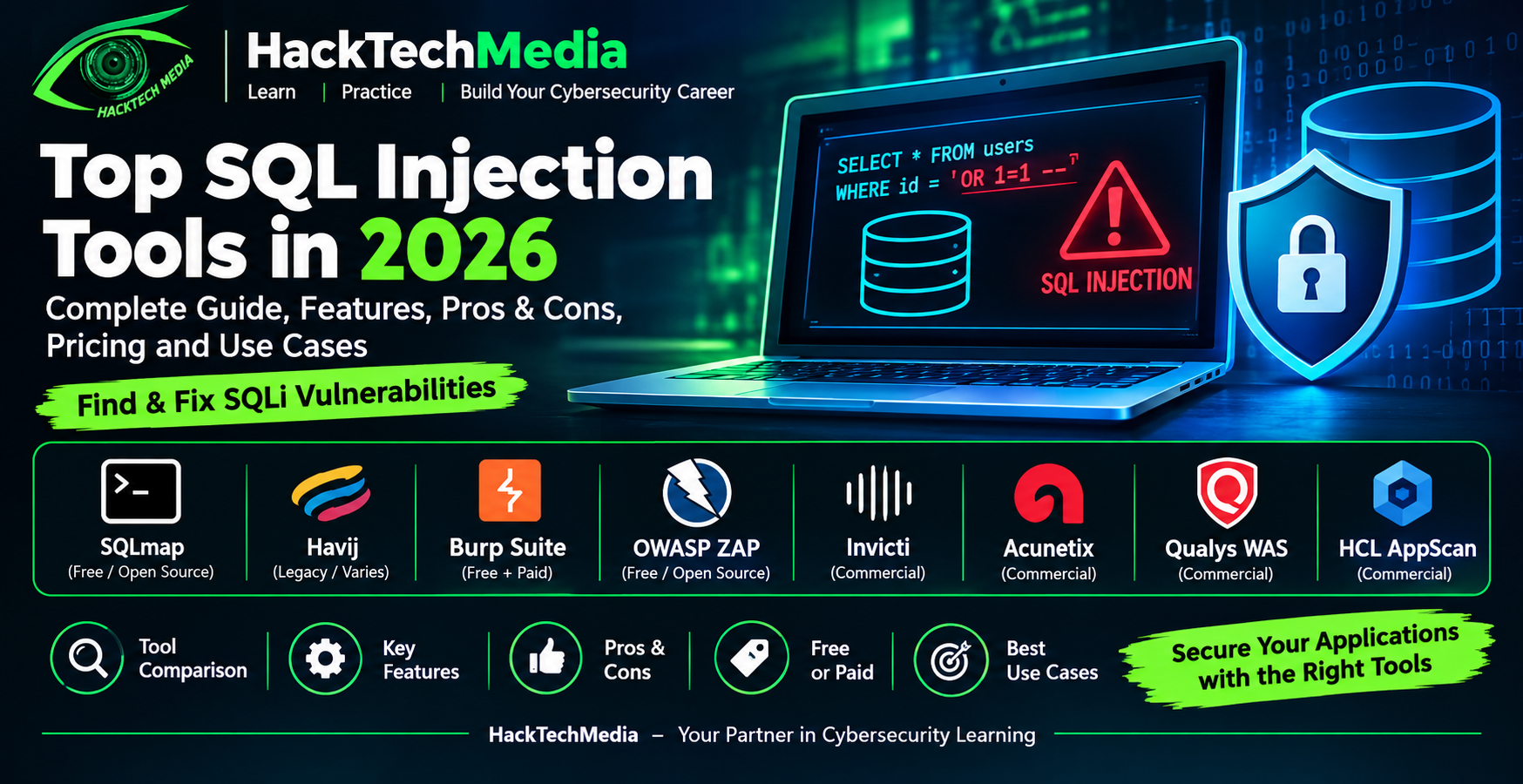
In 2026, the tool landscape includes everything from specialized SQL injection utilities such as SQLmap and Havij to enterprise application security platforms such as Invicti, Qualys WAS and HCL AppScan.
This guide from HackTechMedia compares the major tools, their features, advantages, limitations and licensing models.
Ethical-use note: SQL injection tools should only be used against applications, APIs and systems that you own or have explicit permission to test.
SQL Injection Tools at a Glance
ToolMain PurposeSQLi CapabilityPricing ModelBest ForSQLmapAutomated SQLi testingVery HighFree / Open SourcePentesters and studentsHavijAutomated SQLi testingHighAvailability/licensing should be verifiedLearning legacy SQLi toolingBurp SuiteWeb application security testingHighFree + Paid editionsManual & professional testingOWASP ZAPWeb security testingHighFree / Open SourceStudents and security teamsInvictiDAST / AppSecHighCommercial / QuoteOrganizationsAcunetixWeb vulnerability scanningHighCommercial / QuoteWeb application securityQualys WASCloud-based DASTHighCommercial / QuoteEnterprise securityHCL AppScanDAST/SAST/IAST/SCAHighCommercial / Some free offeringsEnterprise AppSec
Pricing and product packaging can change, so organizations should confirm current commercial pricing with the vendor before purchasing.
1. SQLmap
SQLmap is one of the most widely recognized open-source tools specifically focused on automated SQL injection testing.
It can help security professionals detect SQL injection vulnerabilities and perform database fingerprinting and other authorized assessment activities.
Key Features
- Automated SQL injection detection
- Multiple SQL injection techniques
- Database fingerprinting
- Database enumeration
- Support for many database technologies
- Command-line operation
- Automation capabilities
Pros
- Free and open source
- Highly specialized for SQL injection
- Extremely powerful for penetration testing
- Large security-community ecosystem
- Suitable for cybersecurity labs
- Automation saves considerable testing time
Cons
- Command-line interface can be challenging for beginners
- Requires understanding of SQL injection
- Can generate significant traffic
- Automated results still require professional validation
- Not a complete web application security platform
Pricing
Free / Open Source
Best For
Penetration testers, ethical hackers, cybersecurity students and security researchers.
2. Havij
Havij is a well-known automated SQL injection tool that has historically been used for identifying and exploiting SQL injection vulnerabilities.
MITRE ATT&CK identifies Havij as software that can automate SQL injection.
Havij is particularly notable because of its graphical interface, which made SQL injection testing more accessible to users who were less comfortable with command-line tools.
A 2026 research publication also evaluated Havij under a controlled and ethical test environment and compared its performance with SQLmap.
Key Features
- Automated SQL injection testing
- GUI-based workflow
- Database discovery
- SQL injection exploitation capabilities
- Easier interface for users familiar with graphical security tools
Pros
- GUI-based interface
- Easier to understand than many command-line tools
- Historically popular among security learners
- Useful for understanding automated SQL injection workflows
- Can demonstrate how automated SQLi tools operate
Cons
- Older technology compared with modern enterprise AppSec platforms
- Not designed as a complete modern web application security platform
- Limited suitability for modern API-heavy application architectures
- Users should carefully verify the provenance and safety of any copy they obtain
- Current licensing/distribution status should be verified rather than assuming that an old downloadable copy is officially supported
Pricing
Do not present Havij as a current actively maintained commercial/free product without qualification. Its historical distribution and current availability differ from actively maintained open-source projects such as SQLmap and ZAP.
Best For
Historical study, security education and controlled lab research.
3. Burp Suite
Burp Suite, developed by PortSwigger, is much broader than a SQL injection scanner.
It is a complete web application security testing platform that allows security professionals to intercept, inspect and manipulate HTTP requests.
It can be used for manual SQL injection testing as well as automated security scanning.
Key Features
- HTTP interception
- Proxy
- Repeater
- Intruder
- Scanner
- API testing
- Authentication testing
- Input validation testing
- SQL injection testing
- Extensive extensions ecosystem
Pros
- Excellent for manual security testing
- Powerful request manipulation
- Widely used in professional penetration testing
- Strong API testing capabilities
- Large ecosystem
- Good combination of automation and manual analysis
Cons
- Professional features require a paid edition
- Can be complex for beginners
- Automated scanning can require tuning
- Enterprise functionality can become expensive at scale
Pricing
Free Community Edition + Paid Professional/Enterprise offerings.
Best For
Web application penetration testers and cybersecurity professionals.
4. OWASP ZAP
OWASP ZAP, or Zed Attack Proxy, is a free and open-source web application security testing platform.
The official project describes ZAP as a free, open-source web application scanner with automated and manual testing capabilities.
ZAP also provides SQL injection scanning capabilities.
Key Features
- Web proxy
- Automated scanning
- Active scanning
- Passive scanning
- SQL injection detection
- API testing
- Authentication testing
- Automation
- CI/CD integration
- Extensible add-ons
Pros
- Completely free
- Open source
- No expensive enterprise license required
- Good for students
- Good for cybersecurity training
- Automation capabilities
- Extensible architecture
Cons
- Interface can initially be confusing
- Automated results require validation
- Enterprise support is not equivalent to commercial vendors
- Large applications may require careful configuration
- Requires security knowledge for effective use
Pricing
Free and Open Source.
The ZAP project explicitly states that its add-ons are also free and open source.
Best For
Cybersecurity students, developers, penetration testers and organizations seeking an open-source solution.
5. Invicti
Invicti is a commercial application security platform focused heavily on automated web application and API security.
Its current platform includes DAST capabilities and proof-based scanning designed to validate vulnerabilities.
Invicti can detect and validate SQL injection vulnerabilities across web applications and APIs.
Key Features
- DAST
- Web application scanning
- API security testing
- SQL injection detection
- Vulnerability validation
- Proof-based scanning
- CI/CD integration
- Vulnerability management
- Reporting
- Enterprise application security
Pros
- Enterprise-focused
- Automated scanning
- Vulnerability validation
- Web and API coverage
- Strong reporting
- Integration with development workflows
- Reduces manual validation effort
Cons
- Commercial product
- Pricing is not aimed at individual beginners
- Requires proper configuration for meaningful results
- Can be more than a small organization needs
- Professional security expertise is still required to interpret findings
Pricing
Commercial / Quote-based.
Invicti currently offers packages such as Web + API and AppSec Core, with pricing initiated through a quote/demo process. It also advertises proof-of-concept licenses for evaluation.
Best For
Medium-sized businesses, enterprises, security teams and professional AppSec programs.
6. Acunetix
Acunetix is an important name to include because it has long been associated with automated web vulnerability scanning.
However, there is an important 2026 product-positioning update: the vendor currently states that Acunetix is now Invicti Web + API.
Therefore, a current article should explain the relationship instead of presenting Acunetix as an entirely separate independent platform.
Key Features
Historically and through the current product lineage, Acunetix has focused on:
- Web application vulnerability scanning
- SQL injection detection
- XSS detection
- API testing
- Automated crawling
- Vulnerability reporting
- Authentication testing
- Web application security assessment
Pros
- Strong automated web scanning
- Designed specifically for web applications
- SQL injection detection
- API security capabilities
- Automation
- Enterprise-oriented reporting
Cons
- Commercial licensing
- Not suitable as a completely free learning tool
- Automated scanners cannot replace manual penetration testing
- Pricing requires vendor interaction
- Product naming and packaging have evolved
Pricing
Commercial / Quote-based, with evaluation/demo options available. Acunetix licensing documentation describes evaluation periods and paid licensing.
Best For
Professional web application security teams and organizations.
7. Qualys Web Application Scanning
Qualys Web Application Scanning (WAS) is a cloud-based web application security scanning service.
Qualys states that WAS automatically crawls and tests custom web applications and can identify vulnerabilities including SQL injection and XSS.
Key Features
- Cloud-based scanning
- Automated crawling
- SQL injection detection
- XSS detection
- OWASP Top 10 coverage
- Vulnerability management
- DevSecOps integration
- Large-scale scanning
- Centralized reporting
Pros
- Cloud-based
- Scales to large environments
- No traditional scanner infrastructure required
- Integrates with broader Qualys security ecosystem
- Suitable for enterprise environments
- Automated recurring assessments
Cons
- Commercial platform
- Can be complex for beginners
- Enterprise-oriented
- Requires configuration and tuning
- Pricing is not typically aimed at individual learners
Pricing
Commercial / Quote-based.
Best For
Large organizations, enterprise security teams and organizations already using the Qualys ecosystem.
8. HCL AppScan
HCL AppScan is an enterprise application security platform covering multiple testing approaches.
HCL's current AppScan portfolio includes technologies such as SAST, DAST, IAST and SCA, depending on the product/package.
Its DAST capabilities include testing for SQL injection and other runtime vulnerabilities.
Key Features
- DAST
- SAST
- IAST
- SCA
- SQL injection detection
- API security
- Application security testing
- DevSecOps integration
- Enterprise reporting
Pros
- Broad AppSec coverage
- Multiple testing methodologies
- Enterprise-oriented
- Supports development security workflows
- Suitable for large application portfolios
- SQL injection and other injection testing
Cons
- Commercial licensing can be expensive
- More complex than dedicated SQLi tools
- Requires security expertise
- May be excessive for individual learners
- Enterprise deployments require planning
Pricing
HCL offers multiple licensing models depending on the AppScan product. Current AppScan 360 licensing includes options such as per contributing user, per application and per concurrent usage, with pricing available through HCL.
HCL AppScan also has free/trial offerings for some products. Current third-party pricing information lists AppScan CodeSweep at $0, while enterprise products such as AppScan 360 use contact-sales pricing.
Best For
Enterprise application security and DevSecOps teams.
SQL Injection Tools: Detailed Comparison
ToolFree?Paid VersionGUIAutomationEnterprise UseSQLi FocusSQLmapYesNoNoExcellentMediumVery HighHavijHistorical availability variesHistorical/licensing variesYesHighLowHighBurp SuiteCommunity EditionYesYesExcellentHighHighOWASP ZAPYesNoYesExcellentMedium/HighHighInvictiEvaluation/PoCYesYesExcellentVery HighHighAcunetixEvaluationYesYesExcellentHighHighQualys WASEvaluation/demoYesYes/WebExcellentVery HighHighHCL AppScanSome free/trial offeringsYesYesExcellentVery HighHigh
Note: "Free" means the core product is available without a paid license; evaluation/trial access is different from a permanently free edition.
Pros and Cons by User Type
For Cybersecurity Students
Suitable options include:
SQLmap
- Free
- Powerful
- Excellent for learning SQL injection concepts
- Command-line experience required
OWASP ZAP
- Free
- Open source
- Excellent for learning web application testing
- Broader than SQL injection alone
Burp Suite Community Edition
- Good for learning HTTP and manual web testing
- Some advanced features require paid editions
Havij can also be studied in a controlled environment to understand the history of automated SQL injection tooling, but students should not treat it as a modern replacement for actively maintained tools.
For Professional Penetration Testers
A professional tester may use several tools during one engagement.
For example:
Burp Suite → SQLmap → manual validation → vulnerability documentation → remediation verification
The exact workflow depends on the engagement scope and authorization.
The important point is that no scanner should automatically be treated as proof that an application is vulnerable without appropriate validation.
For Enterprise Security Teams
Organizations managing hundreds or thousands of applications may consider platforms such as:
- Invicti
- Qualys WAS
- HCL AppScan
These platforms are designed to provide broader application-security capabilities, reporting, integrations, vulnerability management and automation.
The choice depends on factors such as:
- Number of applications
- API coverage
- CI/CD requirements
- Cloud/on-premises requirements
- Compliance requirements
- Reporting requirements
- Security-team size
- Existing security ecosystem
- Budget
Dedicated SQL Injection Tool vs Enterprise AppSec Platform
One of the most important distinctions for cybersecurity learners is that these tools are not all competitors in exactly the same category.
Dedicated SQL Injection Tools
Examples:
SQLmap
Havij
These focus primarily on SQL injection testing and related database assessment.
Web Application Security Platforms
Examples:
Burp Suite
OWASP ZAP
Invicti
Acunetix
Qualys WAS
HCL AppScan
These cover SQL injection as one part of a much larger application-security testing process.
This distinction makes the comparison more accurate than simply calling every tool a "SQL injection tool."
Which Tools Are Free?
For students and beginners, the most accessible options include:
SQLmap
Free and open source
OWASP ZAP
Free and open source
Burp Suite
Free Community Edition + paid editions
HCL AppScan
Some free/trial offerings; enterprise products are commercial.
Invicti
Commercial, with evaluation/Proof of Concept options.
Acunetix
Commercial, with evaluation options.
Qualys WAS
Commercial enterprise service.
Havij
Current availability/licensing should be independently verified; do not assume old downloads represent a supported current free edition.
What Should Cybersecurity Students Learn First?
Instead of learning only one automated tool, students should build skills in this order:
1. HTTP and HTTPS
↓
2. HTML and JavaScript basics
↓
3. SQL fundamentals
↓
4. Database architecture
↓
5. SQL Injection concepts
↓
6. Burp Suite or OWASP ZAP
↓
7. SQLmap
↓
8. Manual vulnerability validation
↓
9. Secure coding and SQL injection prevention
↓
10. Professional VAPT reporting
This approach teaches the underlying technology rather than simply teaching students which buttons or commands to use.
How Developers Can Prevent SQL Injection
Security testing is only one side of the problem.
Developers should use:
- Prepared statements
- Parameterized queries
- Proper input validation
- Least-privilege database accounts
- Secure database configuration
- Secure error handling
- Code review
- SAST and DAST testing
- Regular security testing
The objective should not simply be to detect SQL injection, but to prevent the vulnerability from entering production.
Conclusion
SQL injection testing in 2026 involves a much wider ecosystem than a single tool.
SQLmap remains an important open-source SQL injection testing utility, while Havij is useful as a historical example of automated SQLi tooling. Burp Suite and OWASP ZAP provide broader web application testing capabilities.
For organizations requiring enterprise-scale automated application security testing, platforms such as Invicti, Acunetix, Qualys WAS and HCL AppScan provide substantially broader functionality than dedicated SQL injection tools.
The most important lesson for cybersecurity professionals is that tools do not replace knowledge. Understanding HTTP, databases, SQL, application architecture, secure coding and vulnerability validation is essential for effective web application security testing.
Want to learn Ethical Hacking and Web Application Security?
HackTechMedia provides practical cybersecurity training covering VAPT, web application security, ethical hacking, vulnerability assessment, penetration testing and cybersecurity career skills.
Build practical knowledge, understand real-world vulnerabilities and learn how security professionals identify and remediate application security weaknesses.
Start your cybersecurity learning journey with HackTechMedia.