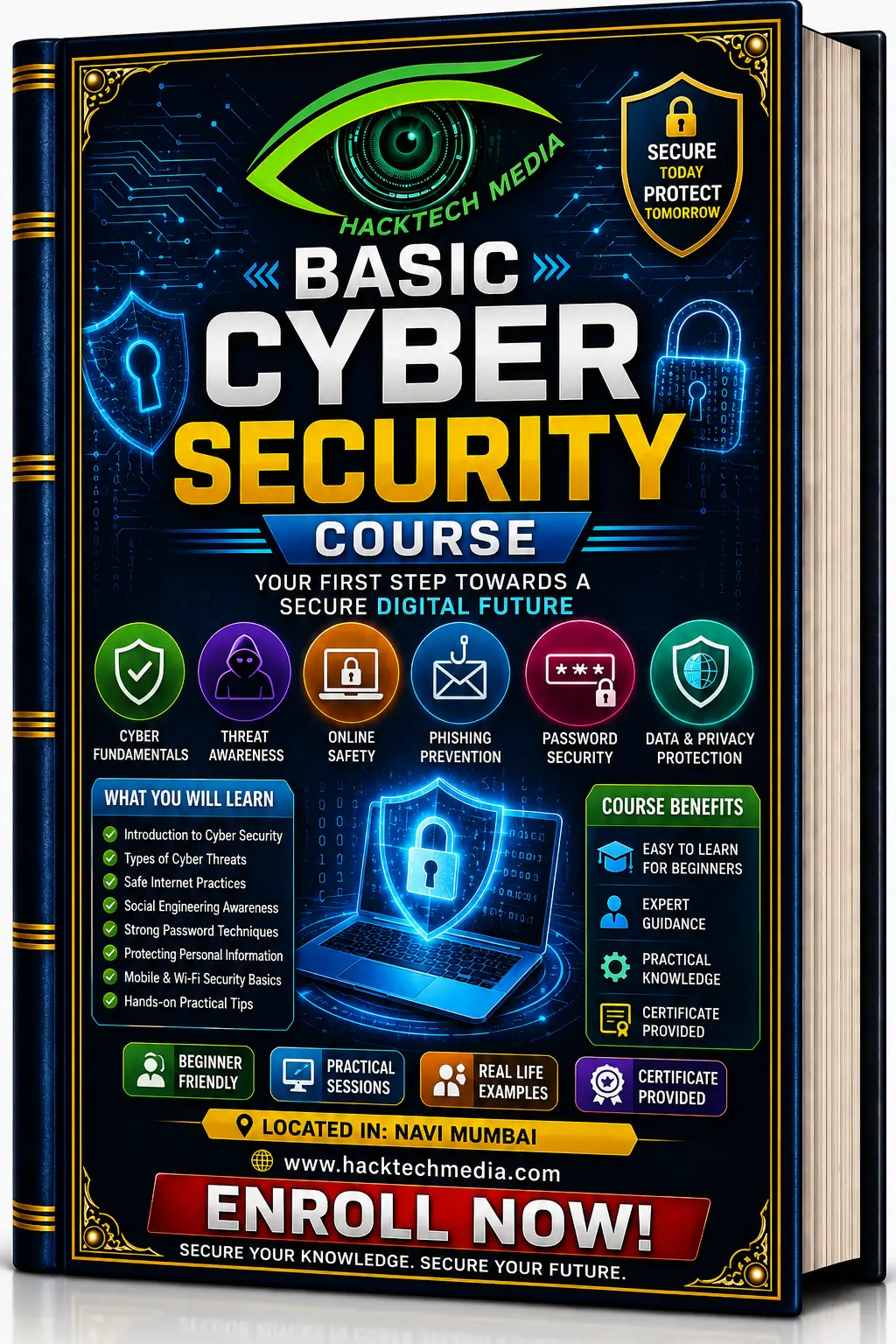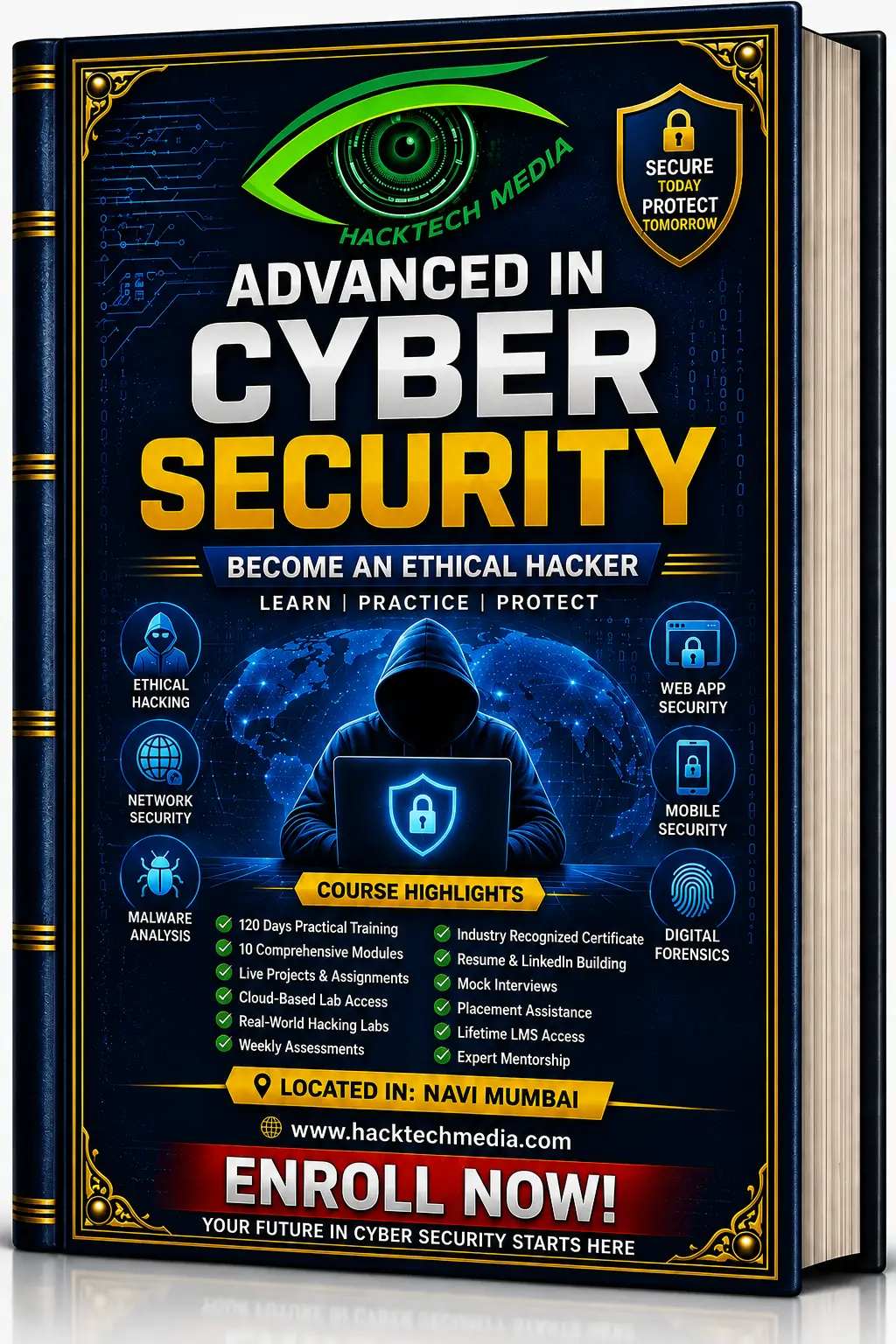

Best Seller Icon Bestseller

Certificate In SOC Analyst(M-CSA-1919)

  • Last updated Oct, 2026
  • Certified Course
₹35,000

Course Includes

  • Duration4 Months
  • Enrolled0
  • Lectures50
  • Videos0
  • Notes0
  • CertificateYes

What you'll learn

4-Month SOC Analyst Course Syllabus

Security Operations Center (SOC) Analyst | Beginner to Job-Ready Training

Course Duration: 4 Months (16 Weeks)

Training Mode: Live Practical Training + Hands-on Labs + Real-World Scenarios

Institute: HackTechMedia, CBD Belapur, Navi Mumbai

Course Objective: To train students to monitor security alerts, investigate cyber threats, analyze logs, detect suspicious activities, respond to security incidents, and work with industry-relevant SOC tools.

Show More

Course Syllabus

Module 1: Cybersecurity Fundamentals

Week 1

  • Introduction to cybersecurity and SOC operations
  • Types of cyberattacks and threat actors
  • CIA Triad: Confidentiality, Integrity, Availability
  • Malware, ransomware, phishing and social engineering
  • Security policies, risk management and security controls
  • SOC Tier 1, Tier 2 and Tier 3 roles
  • Module 2: Networking Fundamentals
  • Week 2
  • OSI and TCP/IP models
  • IP addressing, subnetting and common ports
  • DNS, DHCP, HTTP, HTTPS, FTP and SSH
  • TCP vs UDP, routing and switching basics
  • Firewalls, VPNs, proxies and NAT
  • Wireshark packet analysis fundamentals
  • Module 3: Windows & Linux Fundamentals
  • Weeks 3–4
  • Windows users, groups, permissions and services
  • Windows Event Viewer and Security logs
  • Windows authentication and Active Directory basics
  • Linux commands, users, permissions and processes
  • Linux authentication and system logs
  • PowerShell and Bash basics for security investigations
  • Practical: Identify suspicious login activity from system logs

Month 2: SIEM Tools & Security Monitoring

Module 4: Log Management & Analysis

Weeks 5–6

  • Log sources: Windows, Linux, firewall, endpoint and network
  • Authentication, process and network event analysis
  • Normal vs suspicious activity
  • Failed login attempts and brute-force detection
  • Log correlation and event timelines
  • Introduction to Indicators of Compromise (IOCs)
  • Module 5: SIEM & Microsoft Sentinel
  • Weeks 7–8
  • SIEM architecture and security monitoring workflows
  • Introduction to Microsoft Sentinel and Microsoft Defender
  • Azure portal and Log Analytics workspace fundamentals
  • Connect data sources and configure data collection
  • Kusto Query Language (KQL) fundamentals
  • Search, filter, summarize and correlate security logs
  • Analytics rules, incidents, entities and alert investigation
  • Workbooks, watchlists and automation rule fundamentals
  • Practical: Build a basic detection rule and investigate an incident

Additional exposure: Splunk Enterprise Security concepts and dashboards, depending on lab availability.

Month 3: Threat Detection, EDR & Incident Response

Module 6: Threat Detection & Threat Intelligence

Weeks 9–10

  • Threat intelligence feeds and IOC enrichment
  • IP addresses, domains, URLs, file hashes and reputation checks
  • MITRE ATT&CK framework and adversary tactics
  • Phishing email analysis and malicious URL investigation
  • Malware behavior and ransomware indicators
  • Brute-force, password spraying and account compromise detection
  • Threat hunting fundamentals
  • Practical: Map alerts to MITRE ATT&CK techniques
  • Module 7: EDR & Incident Response
  • Weeks 11–12
  • Endpoint Detection and Response (EDR) fundamentals
  • Microsoft Defender for Endpoint concepts
  • Endpoint alerts, process trees and suspicious behavior
  • Incident response lifecycle
  • Triage, investigation, containment and recovery
  • Evidence collection and incident documentation
  • Escalation procedures and SOC communication
  • Introduction to SOAR and automated playbooks
  • Practical: Investigate a simulated malware alert and write an incident report

Month 4: Advanced SOC Skills & Job Preparation

Module 8: Advanced Security Investigations

Weeks 13–14

  • Advanced KQL queries and multi-event correlation
  • Suspicious PowerShell and command-line analysis
  • Identity and access security investigations
  • Lateral movement and privilege escalation indicators
  • Web and firewall log investigations
  • Detection engineering fundamentals
  • False positives, alert tuning and detection improvement
  • Introduction to cloud security monitoring
  • Module 9: SOC Capstone Project & Career Preparation
  • Weeks 15–16
  • Simulated SOC monitoring and alert triage
  • Investigate multiple security incidents from logs
  • Build KQL queries and detection rules
  • Create an incident investigation timeline
  • Prepare incident reports and escalation notes
  • SOC analyst interview questions and mock interviews
  • Resume preparation and practical assessment
  • Final project presentation


Eligibility

Who can apply for this course

  1. Basic computer knowledge
  2. Networking and Linux fundamentals are included,
  3. so previous SOC experience is not required.


project 1: Microsoft Sentinel SIEM Setup

Connect sample or authorized log sources, run KQL queries, create an analytics rule and investigate a generated alert.

Security Analyst Carefully Examines Email Attachments


Project 2: Phishing Investigation

Analyze a sample email, inspect headers and URLs, identify indicators of compromise, and prepare an investigation report.

Elastic Stack 8 | Monitor Windows with Winlogbeat


Project 3: Brute-Force Attack Detection

Analyze authentication logs, detect repeated failed logins, identify suspicious patterns and build a basic detection query.

CyberGuard AI Agent | Devpost


Project 4: End-to-End SOC Incident Simulation

Triage an alert, investigate evidence, assess severity, document findings and recommend containment and remediation.

Course Structure


Training component

Planned coverage

Duration

4 months / 16 weeks

Theory and concepts

Cybersecurity, networking, operating systems

Tool training

Microsoft Sentinel, KQL, Defender concepts, Wireshark

Practical labs

Log analysis, detection, incident investigation

Projects

4 guided SOC projects

Assessment

Weekly exercises, practical tests and final project

Career preparation

Resume, interview questions and mock interviews

Skills Students Will Develop

By the end of the course, students should be able to:

  • Understand the daily responsibilities of a SOC Analyst.
  • Analyze Windows, Linux, firewall and endpoint logs.
  • Use Microsoft Sentinel to search logs and investigate incidents.
  • Write foundational and intermediate KQL queries.
  • Identify common security threats and indicators of compromise.
  • Follow incident triage, documentation and escalation procedures.
  • Complete guided SOC investigations in a controlled lab environment.

Target job roles: SOC Analyst L1, Security Monitoring Analyst, Junior Cybersecurity Analyst, SIEM Analyst Trainee and Incident Response Trainee.


Course Fees

Course Fees
:
₹35000/-
Discounted Fees
:
₹ 35000/-
Course Duration
:
4 Months

Review

0.0
Course Rating (0 reviews)
0%
0%
0%
0%
0%


Call
Text Message
Review
Brochure
Email
CHAT